The Two-Week Rule: Why Most People Quit in Week 3
Week one is novelty. Week two is discipline. Week three is when the results have not arrived, the soreness has, and the decision actually gets made. What is happening physiologically, and the change that gets people through it.
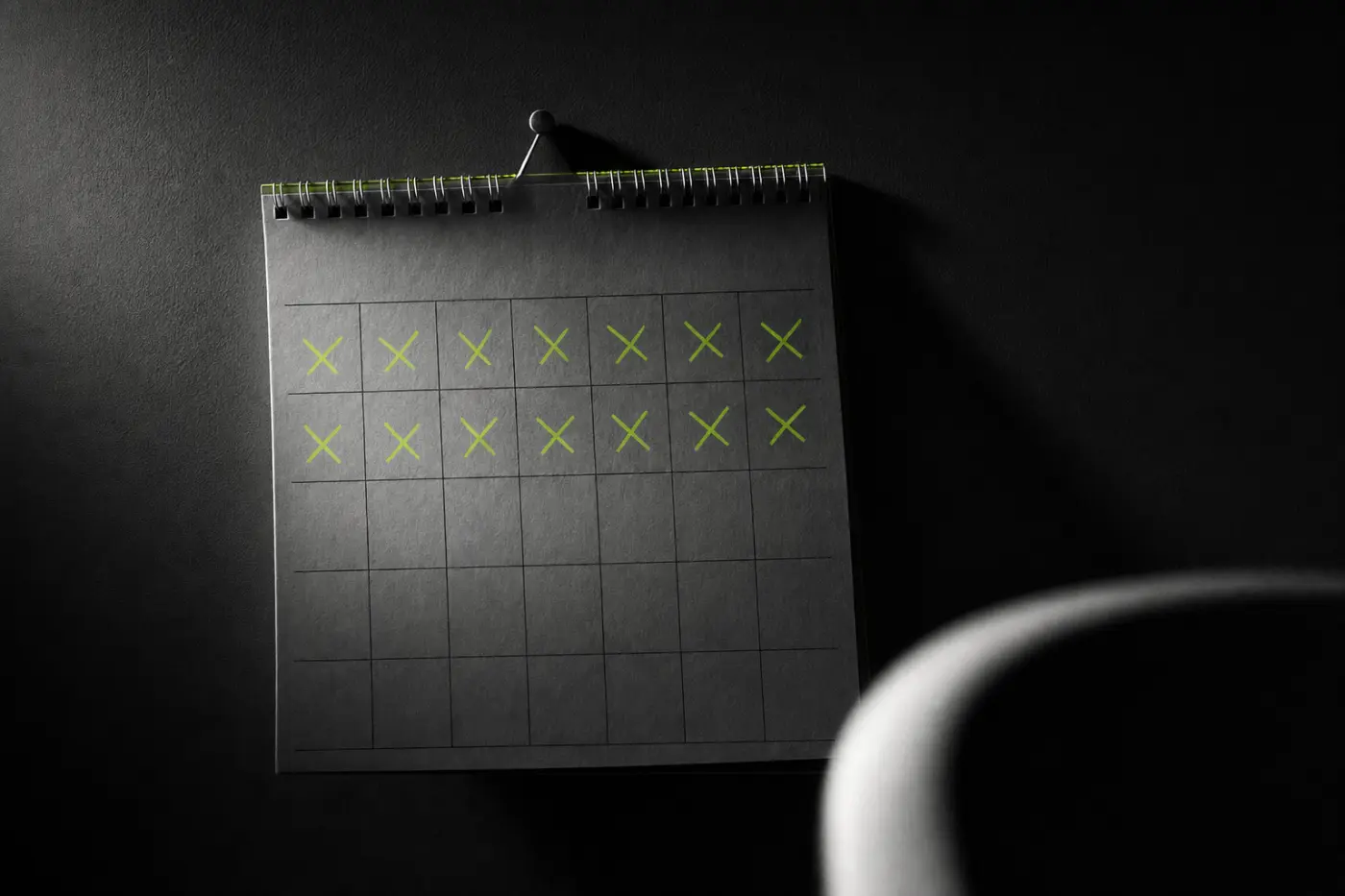
- Week three is the gap between when novelty runs out and when visible results arrive.
- Nothing has gone wrong at week three — your first adaptations are neural and invisible from the outside.
- Visible change typically takes six to eight weeks; strength improvements show up in weeks two to four if you are measuring.
- The fix is to change what you measure, not to change your programme.
- Lower the floor: define the smallest version of a session that still counts, and never skip that.
Nobody quits in week one. Week one is easy — new shoes, new plan, the particular pleasure of being someone who has started. Week two takes discipline but discipline is available; you decided to do this recently enough that the decision still feels fresh.
Week three is where it happens.
By week three, the novelty is gone. The soreness has arrived and stayed. You have looked in the mirror perhaps fifteen times and seen exactly the person you saw on day one. Something comes up on a Tuesday, and for the first time skipping does not feel like failure. It feels reasonable.
That is the moment. Not a dramatic collapse — just one reasonable Tuesday, then another.
Nothing has actually gone wrong
Here is the thing that would help enormously if anyone said it at the start: at week three, your training is working perfectly, and there is no way for you to see it.
The first adaptations to training are neural, not structural. Your nervous system gets better at recruiting the muscle fibres you already have, coordinating them, and firing them in the right order. This is why beginners add weight to the bar quickly in the first month without visibly changing — you are not building much new tissue, you are learning to use what exists.
Meanwhile:
- Measurable strength gains show up in weeks two to four, if you are recording your lifts
- Cardiovascular improvements — resting heart rate, how a given pace feels — appear around weeks three to six
- Visible body composition change typically takes six to eight weeks, longer if you are not in a calorie deficit
- The change other people notice is usually three months or more
So week three sits precisely in the gap: after motivation has depleted, before the evidence arrives. It is not a willpower failure. It is a design flaw in how we choose to measure.
The mirror is the worst possible instrument
If your only feedback mechanism is your reflection, you have chosen the metric with the longest lag, the highest noise and the strongest emotional charge. Daily lighting varies. Water retention varies. Your mood varies, and your mood determines what you see far more than your training does.
Judging three weeks of work by a mirror is like judging a business by checking your bank balance every morning and concluding on day twenty that it has failed.
Change the instrument. Pick something that moves on a weekly timescale and record it:
- The weight on the bar for a given set and rep count
- How many reps you get at a fixed weight
- Your heart rate at a fixed easy running pace
- How you feel on the fourth kilometre versus how you felt in week one
- Sessions completed this week, out of sessions planned
Every one of these will have already moved by week three. That is the whole point — you have evidence, you are simply not collecting it. Whether you keep it in a notebook, a spreadsheet, or an app that surfaces the trend for you matters far less than the fact that something other than the mirror is keeping score.
Lower the floor, not the ceiling
The second fix is structural, and it is the one that separates people still training at month six from people who are not.
Most plans are built around a good day. Ninety minutes, full session, everything completed. Then a bad Tuesday arrives — you slept badly, work ran late, you are not going to do ninety minutes — and because the plan has no version of itself that fits a bad Tuesday, you do nothing.
The problem is not the missed session. It is that missing one makes missing the next one easier, and the identity quietly flips from "someone who trains" to "someone who was training for a bit".
So define the floor explicitly, in advance:
On a bad day, I do fifteen minutes. Two lifts, three sets. Or a twenty-minute easy run. That counts as a session.
The floor is not there for the training stimulus, which is modest. It is there because the streak is the asset, and a fifteen-minute session preserves it while a skipped one does not. People who train for years are not people with better days. They are people with better bad days.
Three weeks is not a habit
The "21 days to form a habit" line is a misreading of a 1960s observation about plastic surgery patients adjusting to their new appearance. The actual behavioural research puts automaticity at a median of around 66 days, with enormous variation — some behaviours take a fortnight, some take the better part of a year, and exercise sits toward the harder end because it requires effort and planning every single time.
This is genuinely useful to know at week three, because it reframes what you are experiencing. You are not failing at a 21-day process. You are roughly a third of the way through a 66-day one, at the point where it is hardest and least rewarding.
The friction you feel is expected. It is scheduled. It is not information about your character.
What week eight looks like
If you get through, the change is not that you become more disciplined. It is that the cost drops.
The soreness stops being constant. The warm-up stops feeling like a negotiation. The gym stops being a place you have to summon energy for and becomes somewhere you simply go on Tuesdays. Somewhere in there you notice you did the session without deciding to, which is the actual definition of a habit.
And the evidence arrives. The bar is heavier. The pace is easier. Someone says something.
But that only happens on the far side of a boring stretch that nobody warns you about. So consider yourself warned: week three will feel like it is not working, and that feeling is not evidence.
Do the fifteen minutes.
Questions people ask
Why do people quit working out after 3 weeks?
Because week three sits precisely in the gap between motivation depleting and evidence arriving. The novelty has gone, the soreness has stayed, and nothing visible has changed — but the first adaptations to training are neural rather than structural, so the work is succeeding in ways a mirror cannot show. It is not a willpower failure; it is a measurement problem.
How long before you see results from training?
Measurable strength gains show up in weeks two to four if you record your lifts. Cardiovascular improvements — resting heart rate, how a given pace feels — appear around weeks three to six. Visible body composition change typically takes six to eight weeks, and the change other people notice is usually three months or more.
How do you stay motivated when nothing is changing?
Change the instrument. The mirror has the longest lag, the highest noise and the strongest emotional charge of any metric available. Track something that moves weekly instead: weight on the bar for a given set and rep count, reps at a fixed weight, heart rate at a fixed easy pace, or sessions completed out of sessions planned. All of these have already moved by week three.
Is it normal to feel worse before better?
Yes, and it is scheduled rather than a sign of failure. The '21 days to form a habit' line is a misreading of a 1960s observation about surgery patients; behavioural research puts automaticity at a median of around 66 days, with exercise toward the harder end because it requires effort and planning every time. At week three you are a third of the way through, at the point where it is hardest and least rewarding.
What should a beginner focus on in the first month?
Lowering the floor rather than raising the ceiling. Define in advance what counts on a bad day — fifteen minutes, two lifts, three sets, or a twenty-minute easy run — because the streak is the asset and a short session preserves it while a skipped one does not. People who train for years are not people with better days; they are people with better bad days.
Keep reading

What the Data Says About Who Actually Sticks With Training
Motivation is not the variable. Across the adherence research, the traits that separate people still training in month six from those who stopped in week three are unglamorous, specific, and almost entirely about friction.

Training Around a Full-Time Job: How Athletes Actually Do It
Nobody with a job trains like a professional, and the plans written by professionals assume you do. The scheduling patterns that survive real work weeks, ranked by how well they hold up when the week goes wrong.

Fitness Myths That Refuse to Die: 12 Things Your Gym Bro Still Believes
Toning, the anabolic window, spot reduction, muscle confusion, sweat as a measure of anything. Twelve claims that survive purely on repetition, with what the evidence shows and the grain of truth each one started from.