Caffeine for Athletes: Dose, Timing and the Tolerance Problem
One of the few supplements with genuinely strong evidence, and one most people take in a way that blunts it. Effective dosing by bodyweight, timing before a session, whether to cycle off, and what it costs your sleep.
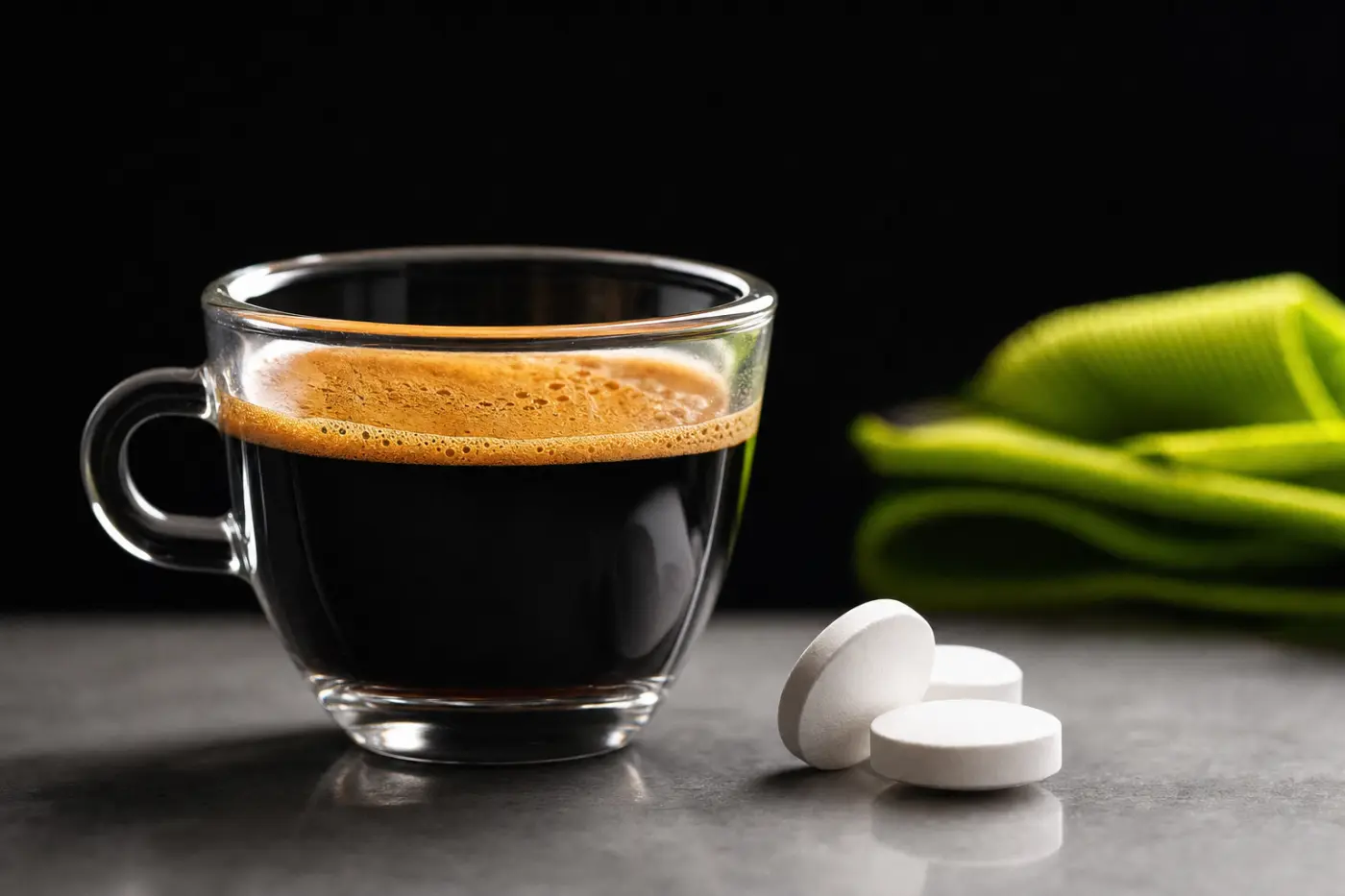
- 3 to 6 mg per kg of bodyweight is the effective range. More is not better.
- Take it 45 to 60 minutes before the session for peak blood levels.
- It works across endurance, strength and repeated-sprint work — a genuinely broad effect.
- Caffeine has a long half-life. An afternoon coffee is still in you at bedtime.
- The performance gain is real but small next to what losing an hour of sleep costs you.
Caffeine is the rare supplement that survives scrutiny. Across endurance work, strength work, repeated sprints and even skill-based tasks, the effect is consistent enough that it sits near the top of virtually every evidence-based supplement list.
Which makes it slightly strange that most people take it in a way that reduces what they get from it.
What it does
The primary mechanism is adenosine antagonism. Adenosine accumulates while you are awake and binds to receptors that make you feel tired. Caffeine occupies those receptors without activating them, so the tiredness signal does not land.
That produces a set of downstream effects that matter for training:
- Perceived effort drops at the same workload. This is the big one — the same pace simply feels easier
- Alertness and reaction time improve
- Pain perception is blunted slightly
- Motor unit recruitment improves modestly, which is where the strength benefit comes from
Notably, this is largely a central effect. Caffeine is not making your muscles stronger. It is changing what your brain does with the signals coming from them, which is why the benefit shows up across such different types of exercise.
The dose
3 to 6 mg per kilogram of bodyweight.
| Bodyweight | Low dose (3 mg/kg) | High dose (6 mg/kg) |
|---|---|---|
| 60 kg | 180 mg | 360 mg |
| 75 kg | 225 mg | 450 mg |
| 90 kg | 270 mg | 540 mg |
Start at the low end. The dose-response relationship flattens quickly — going from 3 to 6 mg/kg adds relatively little, and going above 6 mg/kg adds essentially nothing except side effects: jitteriness, elevated heart rate, gastrointestinal distress and, in some people, anxiety that makes the session worse rather than better.
For reference, a typical filter coffee contains somewhere around 80 to 120 mg, though the variation between brewing methods and beans is enormous. If you need a precise dose, tablets or gum are far more reliable than coffee.
The timing
45 to 60 minutes before the session. Blood caffeine concentrations typically peak somewhere in that window after ingestion.
Two useful exceptions:
Caffeine gum is absorbed through the mouth and acts considerably faster — useful mid-race, or when you do not know exactly when your wave starts.
Long events may benefit from splitting the dose: some before the start, some later. Taking the full amount before a three-hour race means the effect is fading exactly when you need it, which is the last hour.
The tolerance question
This is where most of the confusion sits.
Habitual caffeine use does blunt the subjective effect. The alertness kick that a naive user gets from 200 mg is not what a four-coffee-a-day person experiences.
But the performance effect appears more durable than the subjective one. The evidence broadly suggests that regular users still derive an ergogenic benefit from an appropriate dose, even without the noticeable buzz.
Which makes the popular advice — abstain for a week before an important race to "resensitise" — a poor trade for most people. That week involves headaches, irritability and disrupted sleep, landing precisely during a taper when the entire objective is to arrive fresh and rested. The uncertain gain rarely justifies it.
A more sensible version: keep your normal daily intake, and take a genuine performance dose on race day and before key sessions only. If you want to reduce baseline tolerance, do it in the off-season, not in race week.
The part that actually costs you
Here is where the accounting turns against most people.
Caffeine's half-life is roughly five to six hours, and longer in some individuals depending on genetics, liver function and medication.
Work it through. A 200 mg dose at 4pm leaves roughly:
- 100 mg at 10pm
- 50 mg at 4am
You may well fall asleep. That is not the issue. The issue is that caffeine reduces slow-wave sleep even when sleep onset is normal, and deep sleep is where a disproportionate amount of physical recovery happens.
So the trade is: a small, real performance benefit this afternoon, against a measurable reduction in the quality of the recovery that determines whether you can train well tomorrow.
For a hybrid athlete training most days, that trade is usually bad. Sleep is the largest recovery input you have — the full case is in sleep is the only legal performance enhancer — and a supplement that improves one session while degrading the recovery from all of them is not a good deal.
The practical policy
- Cut-off time: eight hours before bed, and ten if you are sensitive. For an 11pm bedtime that means nothing after 3pm.
- Save the real dose for what matters. Races, key sessions, and genuinely hard mornings. Not every training day.
- Use a reliable form when precision matters. Tablets or gum for races; coffee is for enjoyment, where the exact dose is not the point.
- Test it in training first. Gut tolerance varies enormously, and finding out that 400 mg makes you nauseous is a training-day discovery, not a race-day one. This is the same principle as everything else in what to eat the week of a HYROX race.
- If it makes you anxious, use less. Some people get a worse session at doses that help others. The anxious, over-aroused state is not a performance state.
Who should be careful
Caffeine is well tolerated by most people, but not all. Pregnancy, cardiac arrhythmias, uncontrolled hypertension, anxiety disorders and certain medications all change the calculation, and that is a conversation with a doctor rather than an article.
There is also genuine genetic variation in how fast people metabolise it. If a single afternoon coffee reliably wrecks your night, you are probably a slow metaboliser, and no amount of protocol will change that — adjust the cut-off rather than arguing with it.
The summary
3 to 6 mg/kg, 45 to 60 minutes before, on the days that actually matter, and never inside eight hours of bed.
That is a supplement doing genuine work. The version most people run — a large dose daily, often late, chasing a feeling that tolerance removed years ago — is closer to a habit with a performance side effect, and the sleep it costs is worth more than the session it buys.
Questions people ask
How much caffeine should an athlete take?
3 to 6 mg per kilogram of bodyweight — for a 75 kg athlete that is roughly 225 to 450 mg. Start at the low end, since higher doses bring jitteriness, elevated heart rate and gut upset without much additional performance benefit. Above about 6 mg/kg the returns disappear and the side effects do not.
How long before exercise should you take caffeine?
About 45 to 60 minutes, which is when blood concentrations typically peak after ingestion. Caffeine in chewing gum form is absorbed faster and can be taken closer to the start, which is useful mid-race or when the warm-up timing is uncertain.
Does caffeine tolerance reduce performance benefits?
Habitual use does blunt the subjective kick — the feeling of alertness — but the evidence suggests the performance benefit is more resistant to tolerance than most people assume. Regular coffee drinkers still get an ergogenic effect from a proper dose, which is one reason a full withdrawal period is rarely worth the misery.
Should you cycle off caffeine before a race?
Generally not worth it. A few days without caffeine before a big event produces headaches, poor sleep and irritability during exactly the taper week you wanted to feel good in, for a modest and uncertain gain. Most athletes are better served by keeping normal intake and taking a proper dose on race day.
Does caffeine affect sleep and recovery?
Substantially, and more than people realise. Caffeine has a half-life of roughly five to six hours, so a 200 mg dose at 4pm leaves around 100 mg in your system at 10pm. It reduces deep sleep even when you fall asleep normally, and since sleep is the largest single recovery input you have, late caffeine can easily cost more than the training session gained.
Keep reading

Electrolytes and Hydration: How Much Salt Do You Actually Lose?
Sweat rates vary five-fold between athletes and sodium concentration varies even more. How to measure your own instead of guessing, what the numbers mean for a hot-weather session, and why most electrolyte tabs are underdosed.
Gut Training: How to Stop Your Stomach Ruining Long Races
Your gut is trainable, and most people never train it. Why fuelling that works in a lab fails at kilometre thirty, how to build carbohydrate tolerance over eight weeks, and what to do when it goes wrong mid-race.
What to Eat the Week of a HYROX Race (Hour by Hour)
From the Monday before to the moment you walk into the corral. Carb targets, the fibre mistake almost everyone makes, caffeine timing, and exactly what to do in the ninety minutes before your wave.