Gut Training: How to Stop Your Stomach Ruining Long Races
Your gut is trainable, and most people never train it. Why fuelling that works in a lab fails at kilometre thirty, how to build carbohydrate tolerance over eight weeks, and what to do when it goes wrong mid-race.
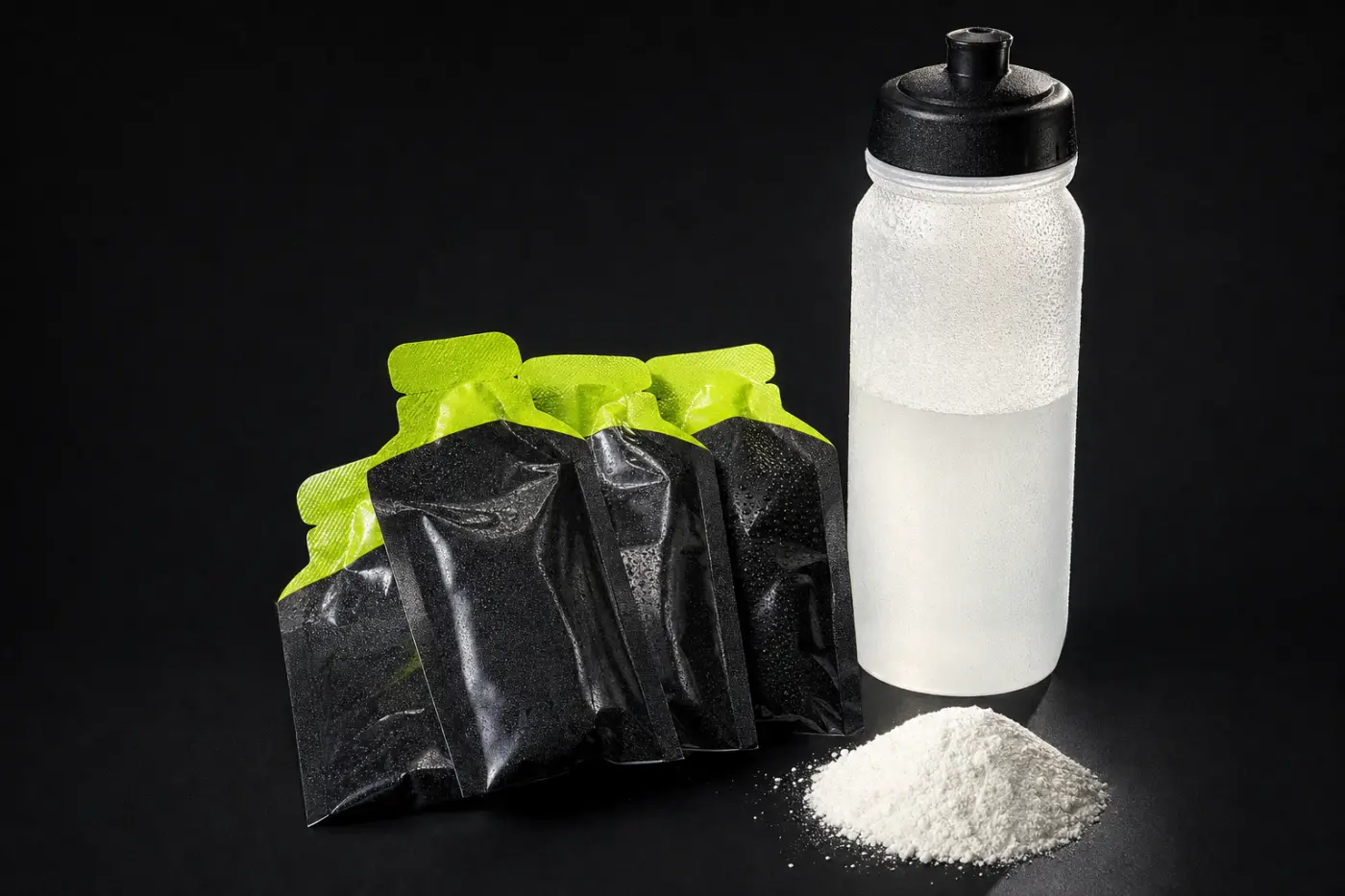
- Carbohydrate absorption is trainable. The transporters upregulate with repeated exposure.
- Practise race fuelling in training, at race intensity, not just on easy long runs.
- Glucose and fructose together allow higher absorption rates than glucose alone.
- Build gradually over 6 to 8 weeks. Doubling your intake next Sunday will not go well.
- Most race-day GI distress is an untrained gut, not a bad product.
Almost everyone who has raced long has a version of this story. The fuelling plan was sound, the numbers came from a reputable source, and somewhere after two hours the stomach simply refused — nausea, cramping, a portaloo, or the specific misery of carrying a gel you cannot face.
The plan was probably fine. The gut had just never been asked to do it before.
The gut is a trainable organ
This is the part that surprises people, and it is the most useful fact in endurance nutrition.
Carbohydrate does not diffuse into you. It is moved across the intestinal wall by specific transport proteins, and the density and activity of those transporters adapts to habitual intake. Feed your gut a lot of carbohydrate during exercise, regularly, and it gets better at absorbing carbohydrate during exercise.
Which means absorption capacity is not a fixed personal trait. It is a trained quality, like your threshold pace, and it responds to progressive overload in much the same way.
The corollary is the uncomfortable one: if you never practise fuelling, you arrive at your race with an untrained gut and a plan written for a trained one.
Why it fails specifically during racing
Three things stack up.
Blood flow moves away from the gut. During hard exercise, blood is redirected to working muscle and skin. Splanchnic blood flow can fall substantially, and digestion is not a priority function when you are running at threshold.
Mechanical jostling. Running is uniquely bad here — the repeated impact is far harder on the gut than cycling, which is why cyclists routinely tolerate fuelling volumes that would destroy a runner.
Heat and dehydration make both worse. Both reduce gut blood flow further, which is why GI problems spike in hot races. If you race in Indian summer conditions, this compounds with everything in running in Indian heat.
So the gut is being asked to do more work with less blood, while being shaken. That it works at all is somewhat impressive.
The glucose and fructose trick
Here is the mechanism worth understanding, because it sets the ceiling.
Glucose is absorbed largely via one transporter, and that pathway saturates at roughly 60 g per hour in most people. Beyond that, adding more glucose does not add absorption — it adds undigested carbohydrate sitting in your gut drawing in water, which is precisely the recipe for cramping and nausea.
Fructose uses a different transporter. So combining the two allows total absorption well above the glucose-only ceiling, because you are using two roads instead of one. Commercial products describe this as a glucose:fructose or maltodextrin:fructose ratio, commonly around 2:1 or 1:0.8.
This is why "just take more gels" fails and why product choice genuinely matters above about 60 g an hour.
Realistic hourly targets
| Duration | Carbohydrate per hour | Notes |
|---|---|---|
| Under 60 min | None needed | Water is fine |
| 1–2 hours | 30–60 g | Single source is adequate |
| 2–3 hours | 60–90 g | Glucose + fructose from here |
| 3 hours+ | 60–90 g, sometimes more | Well-trained guts only at the top end |
Elite athletes reporting very high intakes — 100 g an hour and above — have generally spent years building that tolerance deliberately. It is an outcome of training, not a starting point.
The eight-week protocol
Treat it exactly like a training progression: start below your current ceiling, add gradually, and practise at the intensity you will race at.
Weeks 1–2. Take 30 g of carbohydrate per hour on every long run. Even if the run is short enough not to need it. The point is exposure, not fuelling.
Weeks 3–4. Move to 45 g per hour. Introduce the specific products you intend to race with. Note anything that disagrees with you now, while it is cheap to find out.
Weeks 5–6. Move to 60 g per hour, and switch to a glucose–fructose blend if you are targeting more than that. Do at least one session at race intensity rather than easy long-run pace.
Weeks 7–8. Reach your target rate — 75 to 90 g per hour for most marathon and long-course athletes. Rehearse the exact race-day plan at least twice, including timing, at race effort.
Two rules that carry the whole protocol:
Practise at race intensity. A gut that copes fine at easy long-run pace may fail at marathon pace, because that is when blood flow is genuinely diverted. Fuelling practice on easy runs alone is close to useless as a test.
Change one variable at a time. New product, new rate and new intensity in the same session tells you nothing when it goes wrong.
When it goes wrong mid-race
It still will, occasionally. The response matters.
Slow down. This is the only intervention that reliably works, because it restores gut blood flow. Two minutes easier is a far better trade than the ten minutes you lose stopping.
Switch to fluid carbohydrate. A drink is tolerated when a gel is not. If you cannot face either, take water and accept a lower rate.
Stop taking on more for fifteen minutes. Adding fuel to a gut that is already backed up makes it worse.
Rinse and spit if nauseated. Carbohydrate mouth rinsing has a genuine, if modest, effect on perceived effort via receptors in the mouth, with nothing to absorb. Useful in the last hour when nothing else will go down.
The predictable mistakes
Fuelling only on easy runs. The most common and the most misleading.
New product on race day. The single largest avoidable risk in endurance racing, and it happens constantly because of the free samples in the expo bag.
High fibre in the 24 hours before. Ruins more races than glycogen depletion does — covered in what to eat the week of a HYROX race, and the principle is identical for a marathon.
Under-drinking with concentrated carbohydrate. Highly concentrated solutions draw water into the gut. If you take a lot of carbohydrate with little fluid, you get exactly the cramping you were trying to avoid.
Assuming a bad experience means "I can't tolerate gels". Usually it means you took them at a rate your gut had not trained for.
The reframe
Endurance athletes will spend six months building an aerobic base and then leave the digestive half of the race entirely to chance.
But the gut sets a hard ceiling on how much fuel gets in, and fuel is what determines whether the last hour is a race or a survival exercise. It is trainable, it takes about eight weeks, and it costs nothing except doing on your long runs what you were going to do on race day anyway.
Train the gut like a muscle. It is closer to being one than most people assume.
Questions people ask
What is gut training for runners?
Deliberately practising race-day carbohydrate intake during training so your gut adapts to absorbing it. The transport proteins that move carbohydrate across the intestinal wall upregulate with repeated exposure, which means absorption capacity is a trained quality rather than a fixed personal limit.
Why does my stomach hurt when running?
Three things stack up during hard running: blood flow is diverted away from the gut to working muscle and skin, the repeated impact of running jostles the digestive tract far more than cycling does, and heat or dehydration reduce gut blood flow further. Carbohydrate that cannot be absorbed then sits in the gut drawing in water, which produces the cramping and nausea.
How many carbs per hour can you absorb?
Glucose alone saturates its transporter at roughly 60 g per hour for most people. Combining glucose and fructose uses a second transport pathway and allows meaningfully more — commonly 75 to 90 g per hour for well-practised endurance athletes. Intakes above that are achievable but generally reflect years of deliberate gut training.
How do you train your gut to take more carbs?
Progress it like any training quality over six to eight weeks: start at 30 g per hour on long runs, move to 45, then 60, then your target rate, introducing a glucose–fructose product once you go past 60. Crucially, practise at race intensity rather than only on easy long runs, and change one variable at a time.
What should you do if you get GI distress mid-race?
Slow down first — it is the only intervention that reliably works, because it restores blood flow to the gut. Switch from gels to fluid carbohydrate, stop taking on more for about fifteen minutes, and if you are badly nauseated, rinse a carbohydrate drink in your mouth and spit it out, which still reduces perceived effort slightly with nothing to absorb.
Keep reading

Caffeine for Athletes: Dose, Timing and the Tolerance Problem
One of the few supplements with genuinely strong evidence, and one most people take in a way that blunts it. Effective dosing by bodyweight, timing before a session, whether to cycle off, and what it costs your sleep.

Electrolytes and Hydration: How Much Salt Do You Actually Lose?
Sweat rates vary five-fold between athletes and sodium concentration varies even more. How to measure your own instead of guessing, what the numbers mean for a hot-weather session, and why most electrolyte tabs are underdosed.
What to Eat the Week of a HYROX Race (Hour by Hour)
From the Monday before to the moment you walk into the corral. Carb targets, the fibre mistake almost everyone makes, caffeine timing, and exactly what to do in the ninety minutes before your wave.