HRV, Explained Without the Hype: What Your Score Is Actually Telling You
Heart rate variability is a genuinely useful signal wrapped in a lot of marketing. What it measures, why absolute numbers are meaningless between people, and the only way to read yours that holds up.
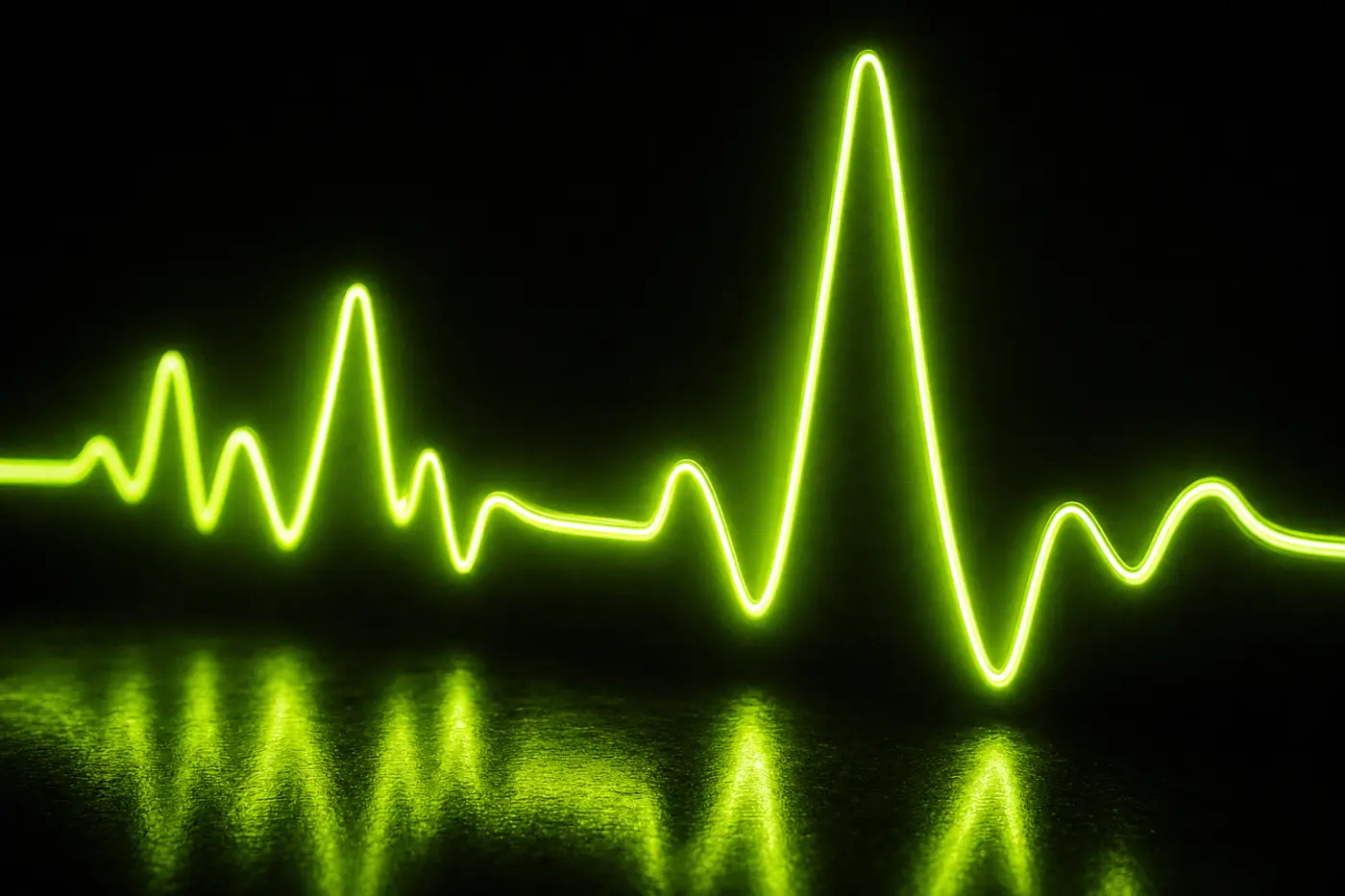
- HRV measures the variation in time between heartbeats — a proxy for how much your parasympathetic nervous system is in charge.
- Absolute values are close to meaningless between people. Genetics and age move the number more than fitness does.
- Only your own rolling baseline is informative, and it takes about 60 days of consistent measurement to establish one.
- A single low day is noise. A week trending below baseline while training holds is a signal.
- Alcohol, late meals, illness and heat all suppress HRV independently of training — read the score in context.
Your heart is not a metronome. At 60 beats per minute it is not beating once per second — the gap between beats fluctuates constantly, stretching and compressing by tens of milliseconds in response to your breathing, your posture, your stress and your state of recovery.
Heart rate variability is the measurement of that fluctuation. And counterintuitively, more variation is the good outcome.
What it actually measures
Two branches of your autonomic nervous system are in a constant tug of war over your heart rate. The sympathetic branch — the accelerator — pushes it up and makes the rhythm more regular. The parasympathetic branch — the brake, the rest-and-digest system — pulls it down and introduces variability.
When you are recovered, calm and unstressed, the parasympathetic side has the upper hand and your beat-to-beat intervals vary a lot. When you are fatigued, ill, stressed, dehydrated or three drinks deep, the sympathetic side takes over and the rhythm becomes more metronomic.
So HRV is not a measure of fitness, or of heart health, or of how good your workout was. It is a proxy for which branch of your nervous system is currently in charge — which turns out to correlate usefully with how ready you are to absorb hard training.
Why your number means nothing next to anyone else's
This is the part the marketing skips.
Healthy adult HRV spans something like 20 to over 200 milliseconds depending on how it is measured. Within that spread, the dominant determinants are age and genetics — not fitness. A 24-year-old with an unremarkable training history will frequently out-score a 42-year-old competitive athlete by a wide margin.
Different devices also compute it differently. Most consumer wearables report RMSSD, or something derived from it, measured during sleep. Some sample continuously all night; others take a short window. A chest strap taken on waking gives a different figure again. These are not interchangeable.
Practical consequence: never compare your HRV to a friend's, to a forum average, or to a number you saw in an article. Compare it only to your own trend, measured the same way, at the same time, on the same device.
Establishing a baseline
Your baseline is a rolling average — most platforms use somewhere between 30 and 60 days — and it is the only thing that makes today's reading interpretable.
Getting a usable one requires consistency:
- Same conditions every time. Overnight measurement during sleep is the most reliable for consumer devices because it removes posture, activity and caffeine as variables.
- Every day, not most days. Gaps widen the confidence interval and make outliers look meaningful.
- Two months before you interpret anything. Reading your first two weeks of data will tell you about the noise, not the signal.
Once the baseline exists, most platforms express today's reading as a deviation from it — which is the only presentation that carries information.
Reading it without fooling yourself
Here is the interpretation that actually holds up.
| What you see | What it likely means | What to do |
|---|---|---|
| One day below baseline | Noise, or last night's dinner, or a late session | Train as planned |
| Two or three days below | Accumulated fatigue from a hard block | Keep the session, cut the intensity |
| A week or more below, training unchanged | Genuine under-recovery | Cut volume by a third for a week |
| Sharp single-day drop with elevated resting HR | Often the earliest sign of illness | Rest, and take it seriously |
| Below baseline the morning after a hard session | Entirely expected | Nothing — this is the system working |
That last row deserves emphasis. A hard training session is supposed to suppress HRV the following night. If it never did, the session was not hard. The mistake is treating an expected post-session dip as a reason to back off, which turns your recovery score into a machine for avoiding training.
The things that move it besides training
HRV responds to total load, and training is only part of that. In rough order of how reliably they suppress it:
- Alcohol. The most consistent and dramatic suppressor. Two drinks will often flatten your overnight HRV more than a threshold run.
- Illness, or the day before symptoms appear. Frequently the earliest warning available.
- A late, large or high-fat meal. Digestion runs on sympathetic drive.
- Poor or short sleep, and sleeping in a hot room.
- Psychological stress. A brutal work week reads much like a brutal training week.
- Dehydration and heat exposure.
- Travel, particularly across time zones.
This is why a raw number is close to useless without context, and why "my score is red so I will skip the gym" is usually the wrong inference. The score is telling you your body is under load. Whether that load is your training, your deadline or your dinner determines what you should do about it.
Turning it into a decision
The useful question is never "is my HRV good?" It is "given this reading, what should today's session become?"
- At or above baseline — proceed as planned. If you have been below for a while and have finally come back up, this is the day for the hard session.
- Modestly below — keep the session and the movement, drop the top-end intensity. Intervals become a steady aerobic run; a heavy triple becomes a comfortable set of five.
- Well below, several days running — this is what a deload is for. Cut volume by roughly a third for seven days and watch the trend.
- Well below with symptoms — rest. No score is worth training through a fever.
Most apps stop at showing you the number and leave this decision to you, which is the hardest part and the one you are least equipped to make objectively at 6am. OnlyGains feeds readiness from Apple Health, WHOOP, Oura or Fitbit straight into the plan, so a poor trend reshapes tomorrow's session rather than presenting you with a colour and a shrug.
The honest limits
HRV is a genuinely useful signal and a genuinely noisy one. It has real predictive value for training readiness across a population and across a season. It has considerably less on any given Tuesday for any given person.
Treat it as one input among several — alongside resting heart rate, sleep duration, how the warm-up felt, and whether you actually want to be there. When three of those agree, listen. When only the number is unhappy, train anyway.
Questions people ask
What is HRV?
Heart rate variability is the variation in the time interval between consecutive heartbeats. A heart beating at 60 bpm is not beating exactly once per second — the gaps fluctuate, and that fluctuation is largely driven by the parasympathetic nervous system. More variation generally indicates a body in a recovered, rest-and-digest state; less indicates stress, fatigue or illness.
What is a good HRV score?
There is no good score in absolute terms. Healthy adults range from roughly 20 to over 200 milliseconds depending on age, genetics and measurement method, and the spread between two equally fit people can be five-fold. The only meaningful comparison is your reading against your own rolling baseline.
Why does my HRV drop after alcohol?
Alcohol suppresses parasympathetic activity for many hours after the last drink, so the heart stays under relatively more sympathetic drive overnight. It is one of the most reliable and dramatic HRV suppressors there is — often a larger overnight effect than a hard training session.
Should you train when HRV is low?
Usually yes, but differently. A single low reading is within normal noise and is not a reason to skip a day. Swap intervals for easy aerobic work or cut the heavy sets, and keep moving. Rest fully if low HRV arrives alongside illness, pain, or several consecutive days below baseline.
How long does it take for HRV to show a training trend?
You need roughly 60 days of consistent daily measurement before a baseline is stable enough to interpret, and meaningful training trends usually reveal themselves over a rolling seven-day average rather than day to day. Anyone drawing conclusions from their first fortnight of data is reading noise.
Keep reading
Your Watch Says Recovery Is Low. Should You Train?
The honest answer is almost always yes, but differently. A decision tree for turning a bad recovery score into a modified session rather than a skipped day — and the three situations where you genuinely should rest.
Deload Weeks: How to Know When You Need One (And What to Actually Do)
A deload is not a week off, and 'every fourth week' is not a plan. The specific signals that mean your body is asking for one, and three deload protocols matched to what is actually fatigued.

Ice Baths and Sauna: What the Evidence Says for Strength and Endurance
Cold plunging after lifting appears to blunt the exact adaptation you trained for. Heat exposure appears to do the opposite for endurance. A timing-based guide to using both without cancelling your own work.