Creatine: What It Does, What It Doesn't, and Who Shouldn't Bother
The most studied supplement in sport, and still the most misunderstood. What the evidence supports, what it does to endurance athletes specifically, the loading question, and the people for whom it genuinely does nothing.
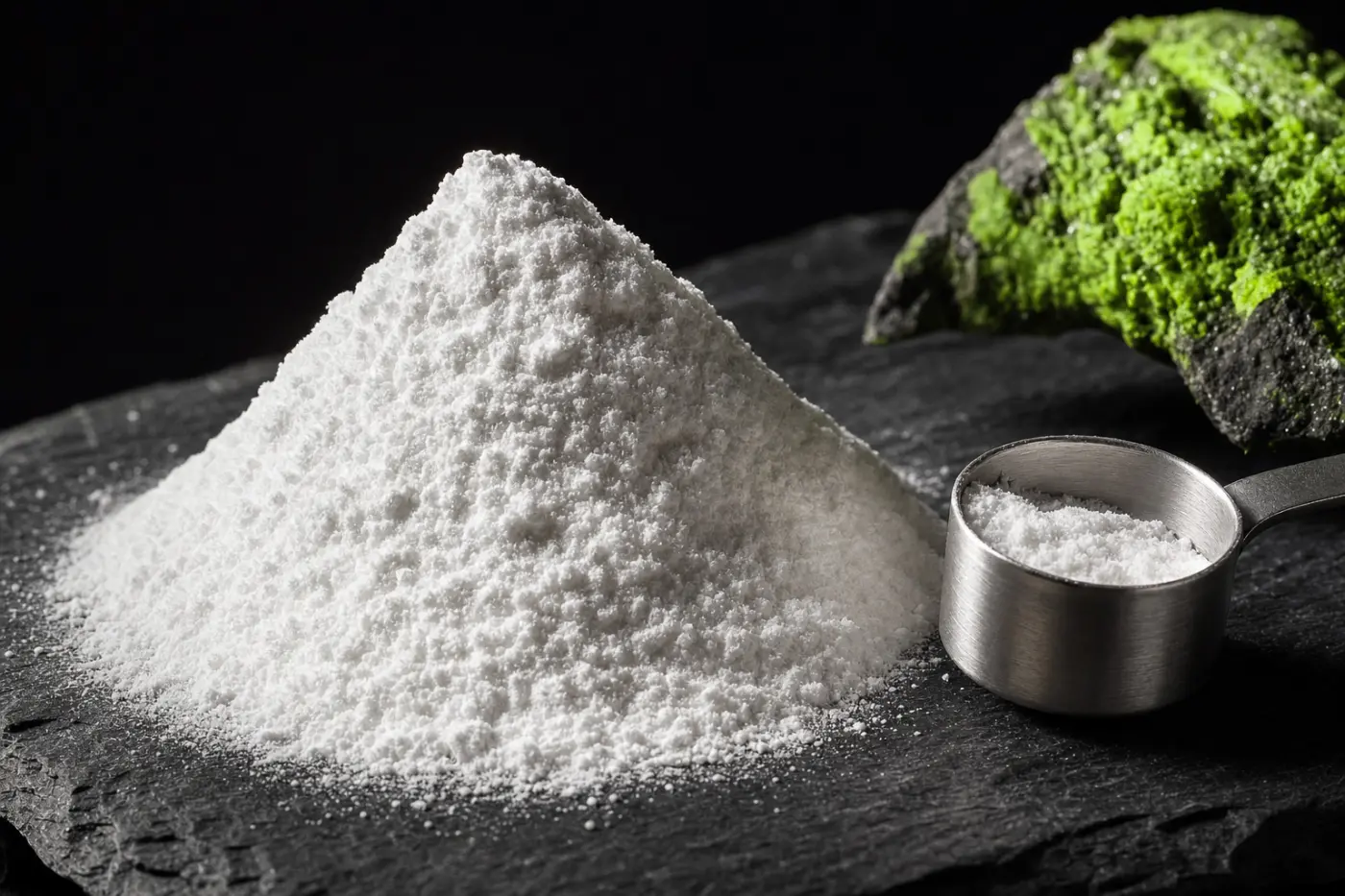
- Creatine helps repeated high-intensity efforts. It does not directly build muscle — it lets you train harder, which does.
- 3 to 5g a day of plain monohydrate. Loading only speeds up the timeline, it does not raise the ceiling.
- The 1 to 2kg you gain early is water inside the muscle, not fat and not bloat.
- It is one of the most-studied supplements there is, with a strong long-term safety record in healthy people.
- Roughly 20 to 30% of people are non-responders, usually because their diet already saturates them.
Creatine is the most researched supplement in sport by a wide margin — hundreds of trials, decades of data, and a rare degree of consensus. It is also surrounded by more folklore than almost anything else in a gym.
Here is what the evidence actually supports.
What it does
Your muscles store a compound called phosphocreatine, which regenerates ATP during very short, very intense efforts — the first five to fifteen seconds of a sprint, a heavy set, a jump. Supplementing creatine raises how much phosphocreatine you store.
The downstream effect is modest and real: slightly more reps at a given load, slightly better repeated sprint performance, slightly faster recovery between hard efforts.
Note the mechanism carefully, because this is where the folklore starts. Creatine does not build muscle. It lets you accumulate more high-quality training volume, and that builds muscle. It is a training amplifier, not an anabolic agent.
Over months, the compounding of "one more rep on most sets" is genuinely meaningful. Over one session it is nearly invisible.
What it does not do
It is not a steroid and works nothing like one. It does not alter your hormones.
It does not cause kidney damage in healthy people. This is among the most thoroughly examined safety questions in sports nutrition, including multi-year trials, and the evidence does not support the concern. If you have existing kidney disease, that is a conversation with your doctor — as any supplement would be.
It does not cause hair loss, on current evidence. This myth traces to a single small 2009 study in rugby players that found an increase in DHT, a hormone associated with male pattern baldness. That study measured a hormone, not hair loss, and has not been replicated. It is a thin basis for a widespread belief.
It does not make you look bloated. The water it draws is intracellular — inside the muscle. Subcutaneous water is what makes people look puffy, and creatine does not do that.
It does not need cycling. There is no evidence your body downregulates its own production in a way that requires breaks.
The loading question
You can do either. They arrive at the same place.
- Loading: ~20g a day, split into four doses, for five to seven days, then 3 to 5g daily. Saturated in a week.
- No loading: 3 to 5g a day from the start. Saturated in three to four weeks.
The end saturation is identical. Loading buys you three weeks of timeline and carries the highest risk of the stomach upset some people get.
Unless you have a specific event three weeks out, skip it. Take 5g a day, forget about it.
Which form
Monohydrate. Plain creatine monohydrate, the cheapest thing on the shelf.
Every other form — hydrochloride, ethyl ester, buffered, liquid, "micronized ultra" — is marketed against monohydrate and none has been shown to outperform it. Monohydrate is also the form nearly every study used, so it is simultaneously the best-evidenced and the least expensive. That is an unusual and pleasant combination.
If you get stomach discomfort, micronised monohydrate dissolves better and often solves it.
Who genuinely should not bother
Non-responders. Roughly 20 to 30% of people see little or no effect, most often because their muscle creatine is already close to saturated. The most common reason for that is eating a lot of red meat and fish, which contain creatine naturally. If you eat meat at most meals, your ceiling for improvement is lower. Vegetarians and vegans typically start furthest from saturation and respond most strongly.
Pure endurance athletes at weight-sensitive events. If you are a marathon or ultra runner, the benefit lands in a quality your event does not test, and you pay 1 to 2kg of body mass to carry over the distance. That is a bad trade. Hybrid athletes who sprint, lift and race short are a different case, and usually should take it.
Anyone whose training, sleep or protein intake is not sorted. Creatine offers a few percent on the margin. If you are training twice a week and eating 60g of protein, the margin is not where your problem is. This is the most common misallocation in supplementation generally.
Anyone with existing kidney disease, without medical advice.
The practical protocol
- 5g per day, every day, indefinitely
- Any time, with or without food — consistency beats timing entirely
- Monohydrate, unflavoured, in whatever you are already drinking
- Give it a month before judging. Saturation is slow.
- Drink normally. It does not require heroic water intake, though being dehydrated is unhelpful regardless.
One more thing worth knowing
There is a growing body of research on creatine and cognition — particularly under sleep deprivation and in vegetarians, where the effects on working memory and mental fatigue appear more pronounced. It is genuinely promising and genuinely not settled.
Do not buy creatine for your brain yet. But it is a reason the risk-benefit calculation looks even better than it did a decade ago, for a supplement that already costs almost nothing and has one of the strongest safety records in the category.
Questions people ask
What does creatine actually do?
It increases the phosphocreatine stored in your muscle, which is the fuel system for very short, very intense efforts — the first 10 or so seconds of a sprint or a heavy set. More phosphocreatine means slightly more reps, slightly faster recovery between sets, and slightly better repeated sprint performance. The muscle you gain comes from the extra training quality, not from the creatine itself.
Do you need to load creatine?
No. Loading with about 20g a day for five to seven days saturates the muscle faster, but taking 3 to 5g a day reaches the same saturation in roughly three to four weeks. The end point is identical. Loading is worth it only if you want the effect immediately, and it is the phase most likely to cause stomach upset.
Does creatine make you gain water weight?
Yes, typically 1 to 2kg in the first few weeks, and it is intracellular — water drawn into the muscle rather than under the skin. It does not make you look puffy; if anything it makes muscles look fuller. It is not fat, and it comes back off if you stop.
Is creatine bad for runners?
Not bad, but the value proposition is weaker. The performance benefit is concentrated in short maximal efforts, which is not what distance running is, and the 1 to 2kg of added weight is a real cost when you are carrying yourself for 42km. For hybrid athletes who also lift and sprint, it is usually still worth it.
Should you take creatine on rest days?
Yes. Creatine works by keeping muscle saturated, which is a slow accumulation rather than an acute effect, so daily consistency matters far more than timing. Take it whenever you will reliably remember, training day or not.
Keep reading

Caffeine for Athletes: Dose, Timing and the Tolerance Problem
One of the few supplements with genuinely strong evidence, and one most people take in a way that blunts it. Effective dosing by bodyweight, timing before a session, whether to cycle off, and what it costs your sleep.

Electrolytes and Hydration: How Much Salt Do You Actually Lose?
Sweat rates vary five-fold between athletes and sodium concentration varies even more. How to measure your own instead of guessing, what the numbers mean for a hot-weather session, and why most electrolyte tabs are underdosed.
Gut Training: How to Stop Your Stomach Ruining Long Races
Your gut is trainable, and most people never train it. Why fuelling that works in a lab fails at kilometre thirty, how to build carbohydrate tolerance over eight weeks, and what to do when it goes wrong mid-race.