Foam Rollers, Massage Guns and What They Actually Do
They do not break up scar tissue, lengthen fascia, or flush lactic acid. What the evidence suggests is happening instead, why the effects are real but short-lived, and where these tools genuinely belong in a week.
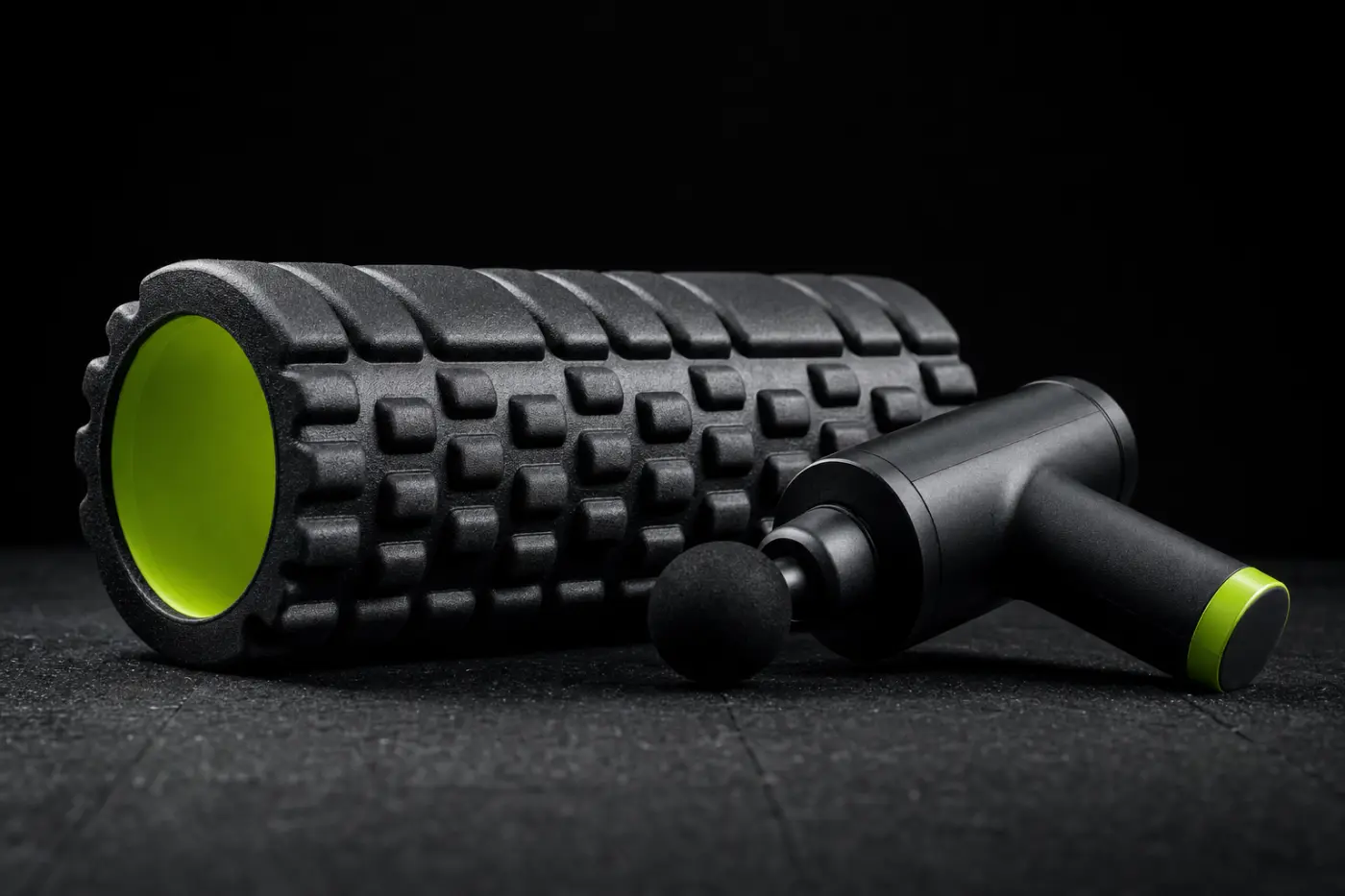
- The mechanism is neural, not mechanical. You are not reshaping tissue.
- Range of motion improves briefly, which makes them useful before training.
- They reduce perceived soreness, which is genuine but is not the same as faster recovery.
- Lactic acid has nothing to do with any of it.
- Good for warming up and feeling better. Not a substitute for sleep, food or load management.
Walk into any gym and you will find someone lying on a foam roller with an expression of genuine suffering, explaining that they are breaking up adhesions in their IT band.
They are not. But they are also not wasting their time, which makes this more interesting than a straightforward debunk.
What the popular explanations get wrong
Three claims dominate, and none survives contact with the evidence.
"It breaks up scar tissue and adhesions." Connective tissue is remarkably strong — the forces required to meaningfully deform fascia are far beyond what a person can generate leaning on a foam cylinder. If you could break up tissue by rolling on it, the roller would be a medical device with a warning label.
"It lengthens the fascia." Fascia is not a material that lengthens on a two-minute timescale and stays lengthened. Whatever range of motion you gain is gone in an hour, which is exactly what you would expect from something that is not a structural change.
"It flushes out lactic acid." This one is wrong twice over. Lactate clears from the blood within roughly an hour of stopping exercise, and it was never the cause of the soreness you feel two days later anyway. Delayed onset muscle soreness relates to muscle damage and inflammation from unaccustomed loading, not to a metabolite that left your system before you got to the car.
The IT band deserves a specific mention, since it is the most rolled structure in any gym. It is a dense band of connective tissue anchored along the femur, and it does not stretch or release. Rolling it hurts a great deal and does not do what people believe. When the IT band is the source of knee pain, the problem is usually hip control — see shin splints, runner's knee and plantar fasciitis.
What is probably happening instead
The best-supported explanation is neural.
Rolling and percussion stimulate mechanoreceptors in skin, muscle and connective tissue. That input alters how the nervous system regulates muscle tone and how it interprets stretch — essentially reducing the protective resistance that limits your range of motion.
You are not changing the tissue. You are changing your nervous system's willingness to let the tissue move, temporarily.
Two supporting observations point the same way:
The effect is not local. Rolling one leg has been shown to improve range of motion in the other leg. That is impossible for a mechanical explanation and entirely consistent with a neural one.
It fades fast. Range of motion gains typically dissipate within an hour or less. Structural change does not behave like that.
There is likely also a pain-modulation component — pressure and vibration influence pain perception through well-described mechanisms, which is why a sore muscle feels better afterwards without having become less damaged.
What the evidence actually supports
Short-term range of motion increase. Consistently found, reasonably well established, and lasts under an hour.
Reduced perceived soreness. Also reasonably consistent. Rolling after hard training makes you feel less sore.
No meaningful strength loss, unlike prolonged static stretching before training. This is what makes rolling a good warm-up component and static stretching a poor one.
Possible small improvement in short-term performance markers when used in a warm-up. The effect is small and the literature is mixed.
What is not established: faster tissue recovery, reduced injury risk, actual repair of anything. Feeling less sore and recovering faster are different claims, and only the first is supported.
Where they belong
In the warm-up. This is the best-evidenced use. Two to three minutes of rolling on the tissues you are about to use, then dynamic movement. You get the range of motion without the temporary strength decrement that a long static stretch would cost.
Before mobility work. Roll, then move through the range you have just gained. The rolling opens a window; the movement is what teaches you to use it.
After hard sessions, for how it feels. Legitimate. Feeling better matters, sleep quality matters, and being less sore makes you more likely to train tomorrow. Just do not confuse it with accelerated recovery.
On travel days and desk days. Genuinely useful for stiffness that comes from sitting rather than from training.
Where they do not belong
As a replacement for the actual recovery levers. Sleep, food and load management do the work. A massage gun does not compensate for six hours of sleep — see sleep is the only legal performance enhancer.
As a treatment for tendinopathy. Tendons need progressive load, not vibration. Attacking an irritated tendon with a massage gun frequently makes it more irritated — tendons adapt slower than muscle covers what actually helps.
As a substitute for strength work. Chronic tightness in the same muscle, week after week, is usually a strength or control problem. The hamstrings that feel tight every single day are frequently weak hamstrings, and rolling them daily manages the symptom indefinitely without touching the cause.
For forty-five minutes. The research uses durations of roughly 30 to 90 seconds per muscle group. Longer is not better, and the time has a genuine opportunity cost.
Practical use
Foam roller: large muscle groups — quads, hamstrings, glutes, calves, upper back. 30 to 60 seconds each. Slow, with a few seconds of pause on the spots that are tender.
Massage gun: more targeted, more convenient, easier on the areas a roller cannot reach. 30 to 60 seconds per area. Avoid bone, joints, and anything acutely injured.
Lacrosse ball: best tool for feet, glutes and shoulder blades, where the roller is too blunt.
A reasonable protocol: five to ten minutes before training on what you are about to use. Optionally a few minutes afterwards, on the basis that it feels good.
What not to do: grind into a painful spot for five minutes hoping something releases. Nothing releases. Pain is not the mechanism, and there is no evidence that more discomfort produces more benefit.
The honest summary
These tools do something real. That something is a short-lived, neurally mediated increase in range of motion and a reduction in how sore you feel. Both are worth having, and both are worth about ten minutes a day.
What they do not do is repair tissue, remodel fascia, clear waste products or replace any part of actual recovery. The gap between what they do and what they are sold as doing is where the entire industry lives.
Use them in your warm-up. Use them after a hard session because you prefer feeling better to feeling worse. Then go to bed on time, which is the intervention that actually works.
Questions people ask
Does foam rolling actually work?
It produces a real short-term increase in range of motion and a real reduction in perceived muscle soreness. What it does not do is any of the things usually claimed for it — breaking adhesions, lengthening fascia or clearing metabolic waste. The effects are worthwhile and considerably more modest and short-lived than the marketing suggests.
Do massage guns break up scar tissue?
No. The forces a handheld percussion device can apply are nowhere near sufficient to remodel connective tissue, which is far stronger than the claim implies. What they do is stimulate mechanoreceptors and alter how the nervous system regulates muscle tone and pain, which is why the effect is immediate and fades within an hour or so.
Should you foam roll before or after a workout?
Before is where the better evidence sits. A brief roll increases range of motion without the temporary strength loss associated with prolonged static stretching, making it a useful part of a warm-up. Rolling afterwards is fine and mostly makes you feel better rather than measurably speeding recovery.
Does foam rolling get rid of lactic acid?
No, and the premise is wrong to begin with. Lactate is cleared from the blood within roughly an hour of exercise and is not the cause of muscle soreness a day or two later. Delayed soreness relates to muscle damage and inflammation from unaccustomed work, which no amount of rolling removes.
How long should you foam roll for?
Somewhere between 30 and 90 seconds per muscle group is typical in the research, and longer sessions do not appear to add much. Ten minutes total is more than enough for a warm-up, and spending half an hour on it is time that would be better spent training or sleeping.
Keep reading
Mobility vs. Flexibility, and Which One You Actually Need
They are not the same thing, and most people chasing one need the other. What the distinction means practically, why strength through range beats passive stretching for athletes, and how little of it you actually require.

Sore Every Day? A Field Guide to DOMS
Soreness is not a measure of a good session and its absence is not a sign of a wasted one. What actually causes DOMS, what genuinely shortens it, and the difference between soreness and the pain you should stop for.
Naps, Sleep Banking and the Athlete's Sleep Debt
You cannot fully repay sleep debt at the weekend, but you can do more than people assume. Nap lengths and timing, whether banking sleep before a hard block helps, and the order to fix things when your nights are genuinely short.