Grip Strength: The Silent Limiter in Every Hybrid Race
Your farmers carry does not end because your legs quit. Grip is the most trainable and most neglected quality in hybrid sport — and it correlates with a surprising amount beyond the gym.
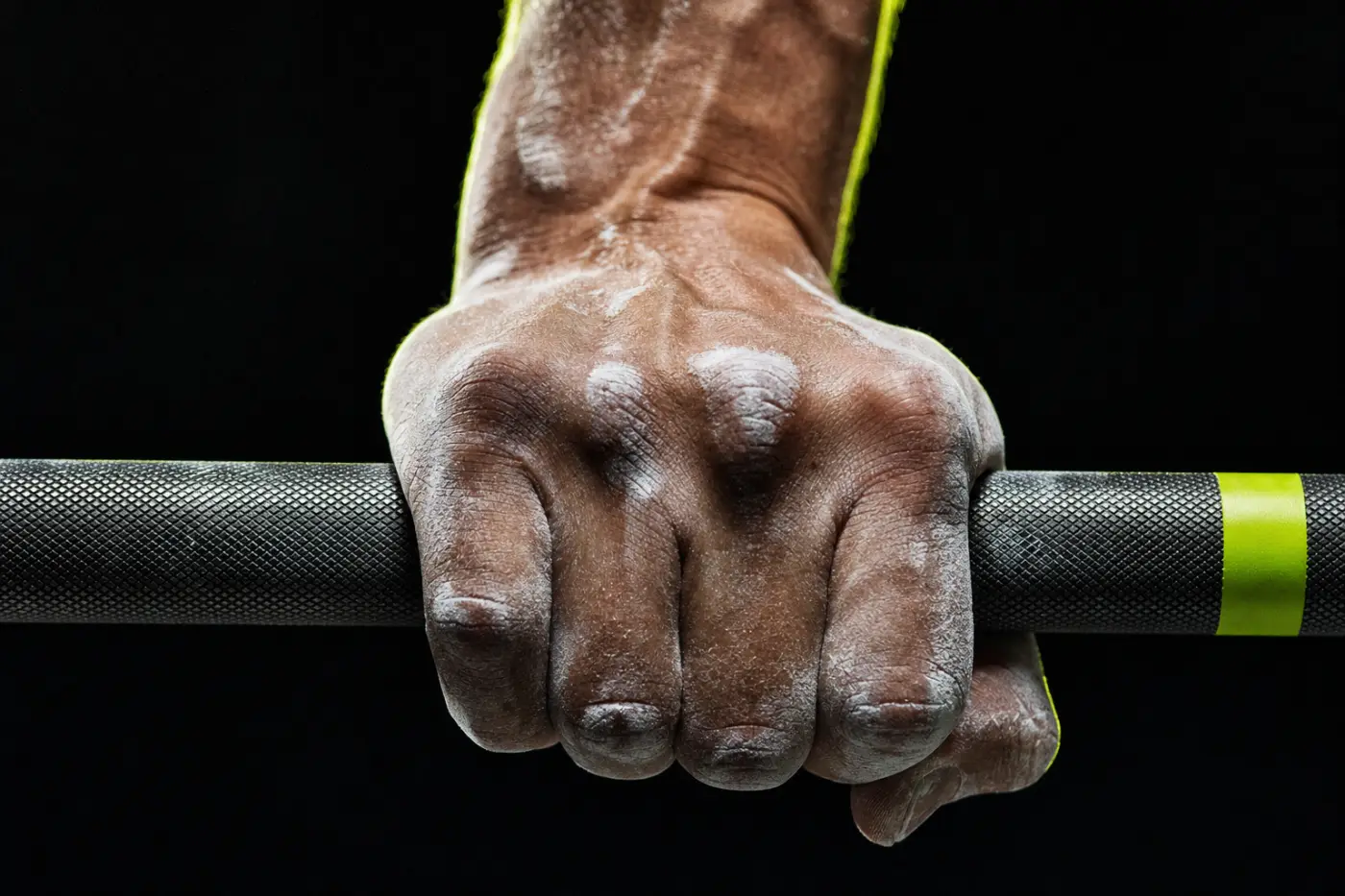
- Three distinct qualities: crush, support and pinch. Racing is almost entirely support grip.
- Support grip is trained by holding heavy things for time — carries and dead hangs.
- Straps are a useful tool for back training and a bad default for hybrid athletes.
- Grip recovers fast, so it can be trained frequently — two or three times a week.
- Grip strength is a well-established population-level health marker, but do not over-read it as a personal diagnosis.
Watch the farmers carry at any HYROX and you will see the same thing repeatedly: athletes putting the handles down with completely functional legs. Their quads are fine. Their lungs are fine. Their hands opened.
The same failure shows up on the sled pull, on the sandbag, and on every deadlift set that ended because the bar rolled out rather than because the hips stopped. Grip is the quality that ends the set while everything else still had capacity — and it is the one almost nobody programmes deliberately.
Three different qualities
"Grip strength" is three separate things, and training the wrong one is why some people do a lot of forearm work and still fail carries.
Crush grip. Squeezing something closed — a handshake, a gripper. This is what people picture, and it is the least relevant to racing.
Support grip. Holding onto something heavy for time. This is the farmers carry, the sled pull rope, the sandbag, the dead hang, the last three reps of a heavy deadlift set.
Pinch grip. Holding something between fingers and thumb with no wrapping. Useful in climbing and strongman, largely irrelevant here.
Hybrid racing is almost entirely support grip. So the training that matters is holding heavy things for time — not squeezing.
That distinction explains a common frustration: people buy a gripper, use it diligently, and find their farmers carry unchanged. They trained the wrong quality.
Why yours fails before your legs
Not because your hands are weak in absolute terms. Because of time under tension.
A set of eight deadlifts loads your grip for roughly 20 seconds. A 200 metre farmers carry loads it continuously for over a minute, at a comparable weight, after you have already run four kilometres.
Your legs have been trained across many rep ranges and durations. Your grip, in most programmes, has only ever been loaded incidentally, in short bursts, as a side effect of training something else. It has never been asked to do a minute.
Add straps to that picture and it gets worse: every heavy pull you did with straps was a set where your back got stronger and your grip got nothing at all.
The training
The good news is that grip responds quickly and recovers fast, which means you can train it two or three times a week without it competing meaningfully for recovery with your legs.
1. Heavy carries — the primary exercise.
Farmers carries with the heaviest implements you can hold. Not for distance, for time under tension: 3 to 4 sets of 30 to 60 seconds, resting fully.
Once you can hold a weight for 60 seconds comfortably, go heavier rather than further. Race demand is a heavy hold, not a light endless one.
2. Dead hangs — the cheapest and most effective.
Hang from a bar, arms straight, feet off the ground. Accumulate two to three minutes total across as many sets as it takes.
Progress by extending each hang, then by adding load with a vest or a dumbbell between the feet, then by using a thicker bar or a towel over the bar. Towel hangs are brutal and transfer well to the sled pull rope.
3. Stop using straps by default.
The single highest-return change for most people, and it costs nothing.
Straps are a legitimate tool for your heaviest back work, where the point is to load the lats beyond what your hands can hold. They are a bad default. Strapping every set of every pull for years is how you end up with a 200 kg deadlift and hands that fail at station six.
Grip everything raw except your heaviest back sets. Use a mixed grip or hook grip on maximal deadlifts if needed — both let you hold more without removing the demand entirely.
4. Rope and towel work, if you race.
The HYROX sled pull uses a rope, and rope grip is meaningfully different from a bar. Rope pulls, towel rows and towel hangs address it specifically, and this is the sort of small specificity that pays for itself in a race — much like practising the first 200 metres out of the roxzone.
Where to put it
Grip work goes at the end of a session, always. Doing it first compromises everything else you were going to hold that day.
A workable arrangement inside an existing week:
- After lower body: 3 × 45 s heavy farmers carries
- After upper body: dead hangs, accumulating 2 to 3 minutes
- Once a week: towel hangs or rope pulls, 3 to 4 sets
Total added time: under ten minutes a week. This is one of the highest return-per-minute additions available to a hybrid athlete, which is precisely why its absence from most programmes is odd — it is not that people decided against it, it is that nobody thought about it at all.
Rough benchmarks
Useful as training targets, not as standards. Bodyweight, hand size and bar thickness all move these considerably.
| Dead hang | Farmers carry hold | |
|---|---|---|
| Developing | Under 30 s | Under 30 s at bodyweight total |
| Solid | 60 s | 45 s at bodyweight total |
| Strong | 90 s+ | 60 s+ at 1.25× bodyweight total |
If you are under 30 seconds on a dead hang, grip is genuinely limiting you and eight weeks of the work above will change your racing noticeably.
The health angle, honestly
Grip strength appears constantly in epidemiology, and it is worth stating precisely because it gets overstated.
In large population studies, grip strength associates with all-cause mortality, cardiovascular outcomes and functional independence in later life — robustly enough that it is used as a standard clinical measure.
But it is a proxy, not a cause. Grip is easy to measure and correlates with overall muscular strength, nutritional status, neurological function and general health. Those things drive the outcomes. Squeezing a gripper does not extend your life; being a strong, well-nourished, physically capable person is associated with living longer, and grip is a convenient window onto that.
So train it because it is limiting your races and because it tracks something real about total-body strength. Do not train it as a longevity intervention in itself, and do not read your own dead-hang time as a prognosis.
The point
Grip is the rare quality that is cheap to train, quick to improve, and immediately visible in performance. Eight weeks of carries and hangs will show up in your farmers carry, your sled pull, your sandbag and your deadlift simultaneously.
Very little else in training offers that. Most improvements are slow, indirect and hard to attribute. This one you will feel by the end of the second month — and the athletes putting the handles down at station six with perfectly good legs are, without exception, the ones who never did it.
Questions people ask
How do you train grip strength?
For hybrid racing, train support grip — holding heavy things for time. Heavy farmers carries for 30 to 60 seconds, dead hangs accumulated to two or three minutes, and simply not using straps on rows and deadlifts. Two or three sessions a week works because grip recovers faster than large muscle groups.
Why do my hands give out before my legs?
Because your grip is trained for far less time under tension than your legs are. A set of eight deadlifts loads your grip for about 20 seconds; a 200 m farmers carry loads it for over a minute at a similar weight. If most of your pulling has been done in low-rep sets or with straps, your grip endurance was never built to match your leg strength.
Do straps weaken your grip?
They do not actively weaken it, but they remove the stimulus that would have strengthened it. Used for every heavy pull, that adds up to years of your back getting stronger while your grip stands still — which is why so many strong lifters fail a farmers carry. Use straps for your heaviest back work and grip everything else raw.
How long should you be able to dead hang?
As a rough working benchmark, 60 seconds is respectable and 90 seconds or more is strong for a hybrid athlete. Treat it as a training target rather than a standard — it varies with bodyweight, hand size and bar thickness, and a heavier athlete hanging 45 seconds may have stronger hands than a lighter one hanging 70.
Does grip strength predict longevity?
Grip strength is a well-established marker in large population studies, associating with all-cause mortality and cardiovascular outcomes. But it is a proxy for overall muscular strength, nutrition and health status rather than a cause — squeezing a gripper does not extend your life. Read it as a useful population signal, not as a personal diagnosis.
Keep reading
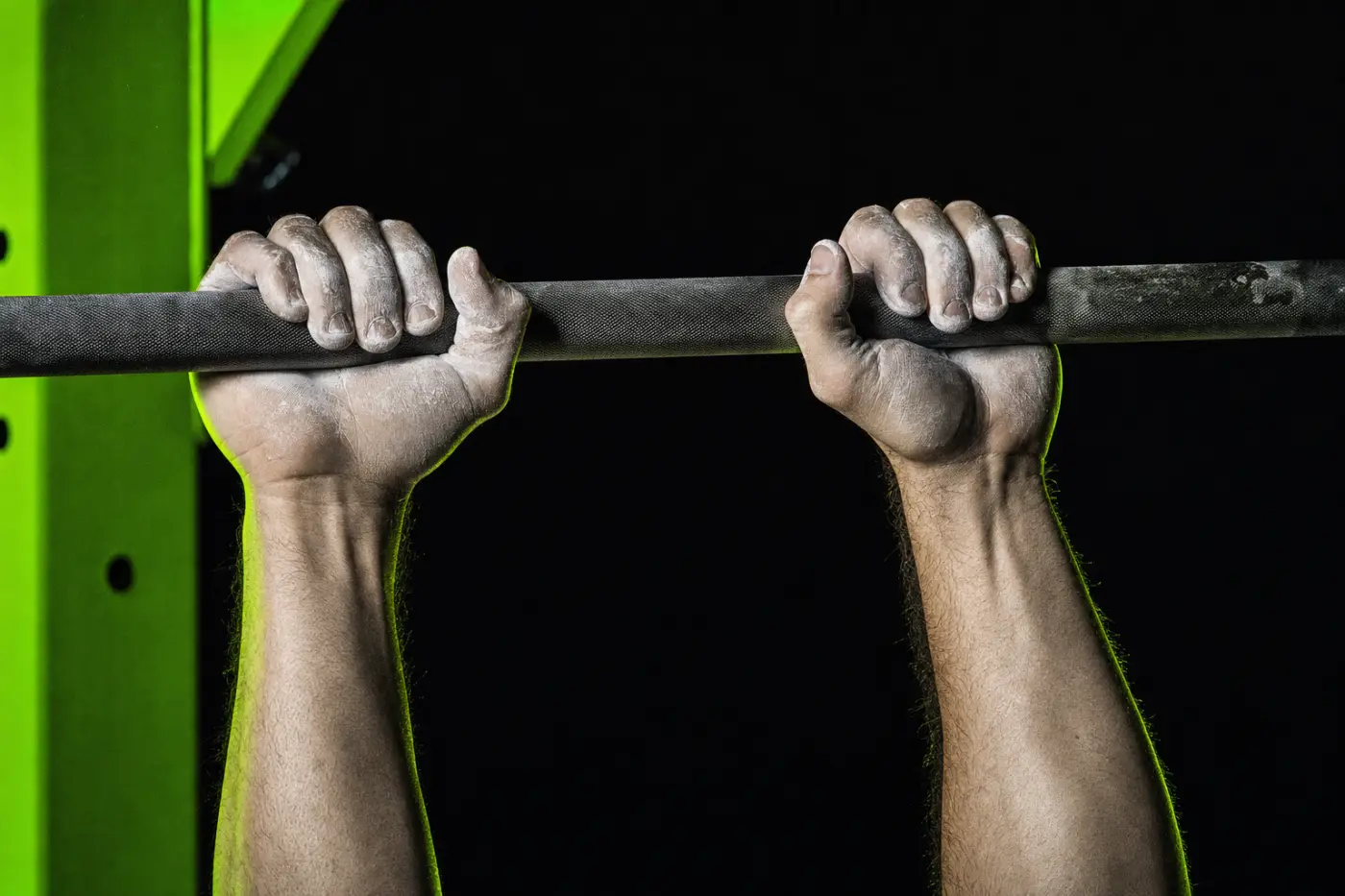
Pull-Up Progression: From Zero to Ten
A staged plan that works whether you are at zero, at three, or stuck at six. The progressions that actually build the movement, the ones that waste months, and how often to train it.
Bulgarian Split Squats: Why They Hurt So Much and Why You Should Do Them
The most hated accessory in strength training is also one of the highest-return exercises for anyone who runs. What makes them disproportionately brutal, how to set up so you train the right thing, and how to program them without wrecking your week.
Progressive Overload When You Can Only Train 3 Days a Week
Adding weight to the bar every week stops working within months. Six other ways to progress, ranked by how long each keeps delivering, built specifically for people whose training frequency is fixed and low.