Bulgarian Split Squats: Why They Hurt So Much and Why You Should Do Them
The most hated accessory in strength training is also one of the highest-return exercises for anyone who runs. What makes them disproportionately brutal, how to set up so you train the right thing, and how to program them without wrecking your week.
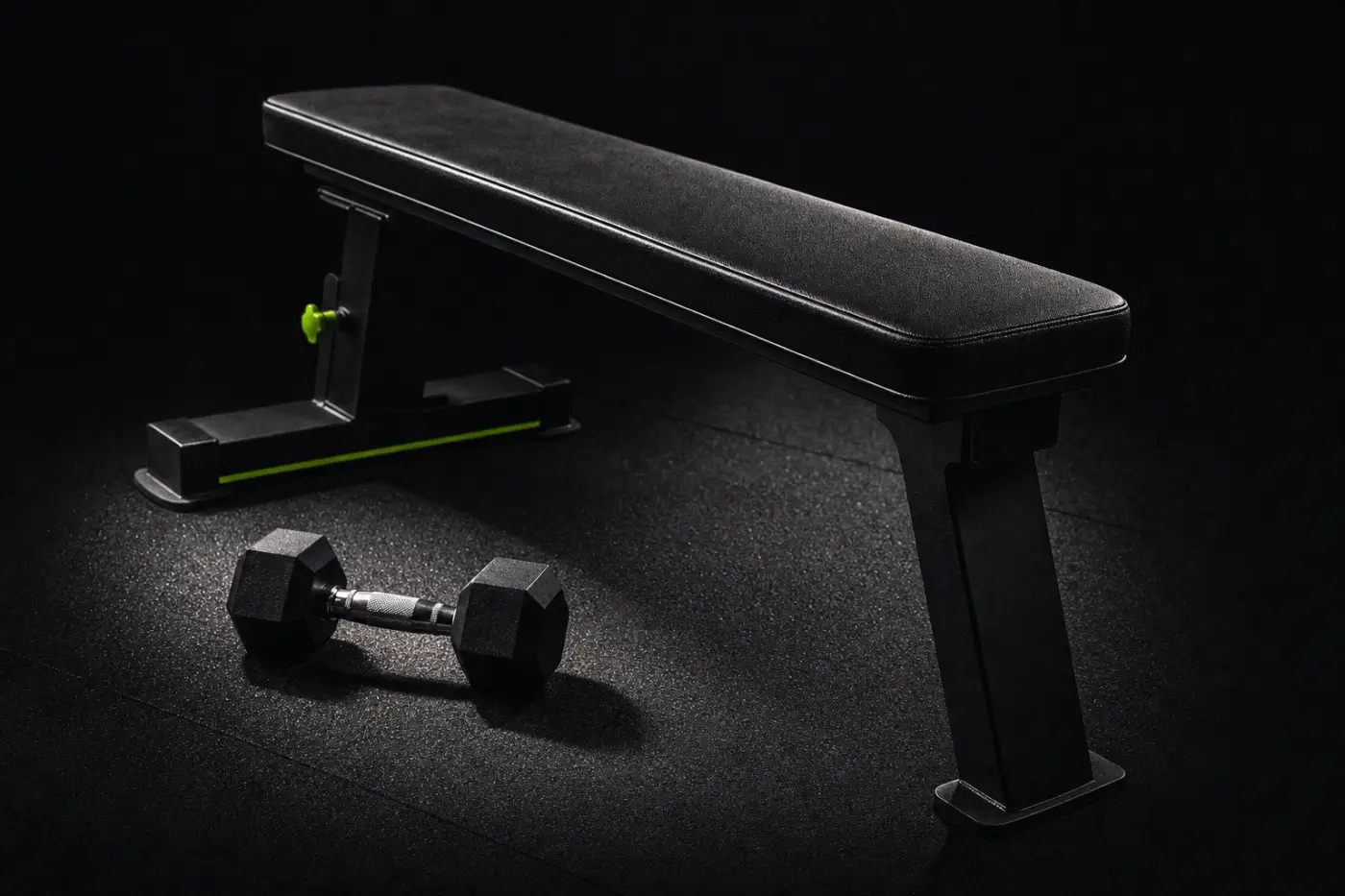
- They feel brutal because the front leg does nearly all the work with almost no base of support.
- Bench height should be around knee height. Higher is not harder in a useful way.
- Foot position sets what you train: further forward loads glutes, closer loads quads.
- Stop at 6 to 10 reps per side. High-rep sets become a balance test, not a strength one.
- Do them after your main lift, not before, and expect the loads to look embarrassing.
There is no exercise people resent more. A pair of dumbbells that would be a warm-up on a back squat becomes, with one foot on a bench, a genuinely unpleasant experience — and everyone's first reaction is that something must be wrong.
Nothing is wrong. The exercise is doing exactly what it is designed to do, and the reason it feels disproportionate is worth understanding, because it explains why it works.
Why they feel so much harder than the weight suggests
Three things stack up at once.
1. The front leg does nearly all the work. In a lunge or a squat, both legs contribute meaningfully. Here, the rear foot is elevated and behind you, in a position where it can provide balance but very little propulsive force. So the load your front leg experiences is far closer to the total than it looks — a 20 kg pair of dumbbells is one leg lifting your bodyweight plus 40 kg, which is not a light squat.
2. Almost no base of support. Your feet are in line rather than side by side, and one of them is barely loaded. The stability demand is enormous, and the muscles managing it — glute medius, adductors, everything around the hip — are working hard without contributing to the lift.
3. Stabilisation in three planes. You are resisting the knee falling inward, the hip dropping, and rotation, continuously, while producing force. A back squat asks for almost none of that.
Add the three and you get a movement where the limiting factor is genuinely the working leg, with none of the systemic escape routes a bilateral lift provides. That is precisely why it is valuable, and precisely why it is horrible.
Why they matter for runners
Running is a single-leg activity. You are never on two feet.
Bilateral squats have a well-known blind spot here: a stronger side quietly takes more of the load, and the bar still goes up. Asymmetries of 10 to 15% are common and completely invisible in a squat. They are not invisible in a split squat, where the weaker side simply cannot do what the stronger side did.
That is diagnostic information you cannot get any other way, and it is why this exercise appears on the short list of lifts a runner actually needs.
The hip stability demand is the second reason. How your knee tracks under load is governed largely by hip strength and control, which is the mechanism behind most patellofemoral pain — and the split squat trains it under load rather than with a band and good intentions.
Setting up properly
Most of the complaints about this exercise are actually complaints about the setup.
Bench height: roughly knee height. Lower if your hip flexors are tight. A high bench feels more advanced and is not — it tips your torso forward, restricts your depth, and converts the movement into a hip flexor stretch you cannot load. If the setup feels like a mobility test, the bench is too high.
Rear foot: laces down, or toes tucked. Laces down is more comfortable for most people. Either is fine; pick one and be consistent so your loads are comparable.
Front foot distance — this is the real variable.
- Further forward → more hip flexion, more glute and hamstring, more upright torso, easier on the knee
- Closer to the bench → more knee flexion, more quad, more stretch through the hip flexor of the rear leg
Neither is correct in the abstract. Pick based on what you are training for, then keep it consistent, because changing your foot position changes the exercise and makes your numbers meaningless.
Torso: slight forward lean is fine and generally better for the glutes. Bolt upright loads the knee more and is not a virtue.
Depth: rear knee to just above the floor, front thigh at or near parallel.
Loading and reps
Dumbbells at your sides is the default and the best option for most people — easiest to bail, no shoulder mobility requirement.
Goblet or front-rack increases the torso demand and reduces the load you can use. Useful, not necessary.
Barbell on the back is a genuinely advanced option, worth doing only once the pattern is solid.
Reps: 6 to 10 per side, 2 to 4 sets.
Past about twelve, the limiter shifts from strength to balance and general fatigue, which is a different and much less useful stimulus. If you can comfortably do fifteen, the answer is more weight, not more reps.
Progression: add weight when you complete all sets at the top of the range with the last rep still controlled. That is the entire model and it works for years — the same double-progression logic covered in progressive overload on three training days a week.
Where they go in the week
After your main lift, never before. They are an accessory. Doing them first will ruin your squat and they do not deserve that priority.
Twice a week is plenty, and once is enough alongside significant running.
Not the day before a long run or a quality session. They produce more soreness than almost any other accessory — a large eccentric component through a long range on a single leg, which is close to a recipe for DOMS.
Start absurdly light. Bodyweight first, for two sessions. The most common mistake is loading them like a squat variation, discovering they are not one, and being unable to walk downstairs for four days.
The asymmetry conversation
You will find one side is weaker. Everybody does.
Train both sides with the load and reps the weaker side can manage. Do not do ten heavy on the right and six struggling on the left — that maintains the gap rather than closing it.
A useful convention: start each set with the weaker side, and match the stronger side to whatever it achieved. Over a few months the gap closes without any special corrective programme.
Do not panic about small differences. A 5 to 10% side-to-side difference is normal and not a problem to be solved. It is worth attention when it is large, when it is growing, or when it comes with pain.
The honest sell
They are unpleasant, the weights look embarrassing on paper, and there is no version of this exercise that feels heroic.
But they expose an asymmetry nothing else finds, they load a single leg hard without loading your spine, they need almost no equipment, and they train the hip control that governs how your knee behaves at kilometre thirty.
Three sets, twice a week, ten minutes total. It is one of the highest returns per unit of effort available to anyone who runs — which is a genuinely irritating thing to be true about an exercise this much fun to skip.
Questions people ask
Why are Bulgarian split squats so hard?
Because the front leg does nearly all the work while your base of support is tiny. The elevated rear foot contributes very little force — it mostly provides balance — so a 20 kg pair of dumbbells loads one leg roughly the way a much heavier bilateral squat would. You are also fighting to stabilise in three planes at once, which adds a demand a back squat never makes.
How high should the bench be for a Bulgarian split squat?
Around knee height, and lower if your hip flexors are tight. Higher benches do not make the exercise more productive — they tip you forward, restrict depth and turn the movement into a hip flexor stretch you cannot load properly. If the setup feels like a mobility test rather than a strength exercise, drop the bench.
Are Bulgarian split squats better than lunges?
For loading a single leg heavily, yes — the elevated rear foot removes more of its contribution than a lunge does, so the front leg gets a larger share at a given weight, and the fixed position lets you focus on force rather than travel. Walking lunges are better for conditioning and for a movement pattern closer to running. Most hybrid athletes benefit from both.
How many reps of Bulgarian split squats should I do?
Six to ten per side, for two to four sets. Past about twelve reps the limiter becomes balance and fatigue rather than strength, which is a different and less useful stimulus. If you can do fifteen comfortably, add weight rather than reps.
Do Bulgarian split squats help running?
Yes, and they are among the highest-return strength exercises for runners. Running is a single-leg activity performed one leg at a time, and bilateral squats let a stronger side quietly compensate for a weaker one. Split squats expose that asymmetry, load each leg independently, and train the hip stability that controls how your knee tracks under load.
Keep reading
Grip Strength: The Silent Limiter in Every Hybrid Race
Your farmers carry does not end because your legs quit. Grip is the most trainable and most neglected quality in hybrid sport — and it correlates with a surprising amount beyond the gym.

Progressive Overload When You Can Only Train 3 Days a Week
Adding weight to the bar every week stops working within months. Six other ways to progress, ranked by how long each keeps delivering, built specifically for people whose training frequency is fixed and low.
Pull-Up Progression: From Zero to Ten
A staged plan that works whether you are at zero, at three, or stuck at six. The progressions that actually build the movement, the ones that waste months, and how often to train it.