Heart Rate vs. Pace vs. Power: Which Should You Actually Run By?
Each metric lies in a different way. Heart rate lags and drifts, pace ignores terrain and heat, power is consistent but poorly validated in running. When to use each, and why effort still beats all three on some days.
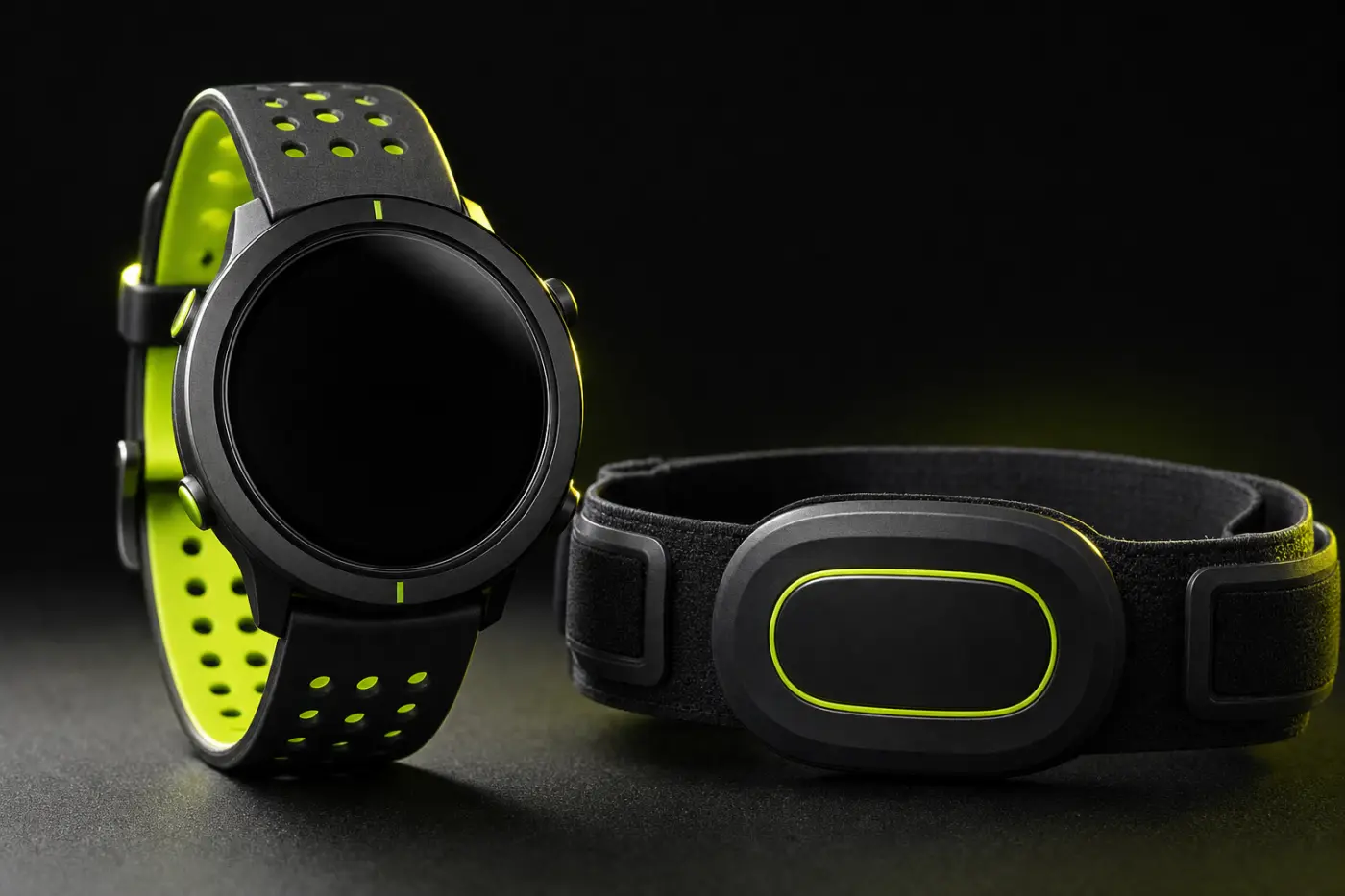
- Every metric is wrong in a specific, predictable way. Knowing how is the skill.
- Heart rate is best for easy running and worst for short intervals.
- Pace is best on flat ground in stable conditions and misleading everywhere else.
- Running power is consistent and responsive, but not a validated physiological measure.
- Perceived effort is the only metric that accounts for everything, and it needs calibrating.
Runners argue about this as though one metric is correct and the others are compromises. They are all compromises. Each is wrong in a specific, predictable direction, and the useful skill is knowing which distortion you are looking at.
Heart rate: what it gets wrong
Heart rate measures the body's response to work, not the work. That distinction produces every one of its failure modes.
It lags. Thirty to ninety seconds to respond to a change in effort. On a three-minute interval, you spend the first minute watching a number that describes what you were doing a minute ago, and the last minute at a value that arrives just as the effort ends. For anything short, it is arriving too late to steer by.
It drifts. Over a long run at genuinely constant pace, heart rate climbs — core temperature rises, plasma volume drops, fatigue accumulates. This is cardiac drift, it is entirely normal, and it means a strict heart rate cap forces you to slow down over the back half of a long run for no training reason.
It responds to everything else. Heat raises it substantially. So does dehydration, poor sleep, caffeine, illness, stress, and a hard session two days ago. On a hot day your easy pace at a given heart rate can be dramatically slower than usual, which is real information about that day and not a fitness assessment.
Wrist optical sensors are unreliable at intensity. Cadence lock — where the sensor picks up arm swing and reports something close to your step rate — is a common and well-documented failure. If your heart rate reads 175 during a warm-up jog, it is not measuring your heart. A chest strap fixes this.
Where it is genuinely good: easy running, long runs, and anything where the failure mode is going too hard. Which happens to be most of your weekly volume — and the discipline it enforces is the entire point of why Kenyan runners jog so slowly.
Pace: what it gets wrong
Pace measures output, which sounds like exactly what you want. Its problem is that identical output can represent wildly different efforts.
It ignores terrain. 5:00/km up a four percent gradient and 5:00/km on the flat are different sessions. Running a hilly route to pace targets means running the climbs too hard and the descents too easy — an argument made at length in hill training.
It ignores heat, humidity and wind. On a hot day, your threshold pace genuinely is slower. Holding your usual number turns a threshold session into a race effort, which is one of the more common ways to wreck a training block in summer.
It ignores fatigue. Prescribed paces assume you arrive fresh. Three weeks into a hard block, the same pace is a different physiological demand.
GPS is imprecise in the moment. Instant pace under trees, between buildings or on a track bounces around enough to be actively unhelpful. Lap pace is trustworthy; the live figure often is not.
Where it is genuinely good: flat ground, stable conditions, threshold and interval work, and anything race-specific. Race day is run at a pace, so training at pace has irreplaceable specificity.
Power: what it gets wrong
Running power is the newest of the three and the most misunderstood, because it borrowed the credibility of cycling power without borrowing the measurement.
It is not measured. Cycling power meters measure force at the pedal or crank. Running power devices estimate it from accelerometer and GPS data using a proprietary model. Different manufacturers produce meaningfully different numbers for the same run, because they are different models rather than different measurements of the same thing.
There is no agreed standard. Which means your power numbers are not comparable to anyone else's, and switching devices resets your entire history.
It does not capture internal load. Power reflects mechanical output. It does not know you slept four hours or that it is 38 degrees.
What it genuinely does well is respond instantly, account for gradient and wind within its model, and stay internally consistent for a given athlete on a given device. On rolling terrain, that combination is legitimately useful — it gives you a single number to hold on a hilly route where pace is meaningless and heart rate is too slow.
The honest position: treat it as a well-behaved personal load index, not as physiology. Used that way it is good. Used as though it were the cycling equivalent, it is overselling itself.
The fourth metric
Perceived effort is the only one that integrates everything — heat, fatigue, sleep, terrain, illness, altitude, how the last session went.
Its weakness is that it needs calibrating, and beginners calibrate it badly. Almost everyone runs easy days too hard and interval sessions too conservatively, at least at first.
The fix is to use the devices to train the perception. Run to heart rate on easy days for a few months, and pay attention to what that feels like. Run intervals to pace, and notice the sensation of the effort you can just sustain. After a while you can reproduce it without looking, and you will have acquired something the watch cannot give you: a metric that works on any terrain, in any weather, on any day, with a dead battery.
Experienced runners are not ignoring their watches out of principle. They have already extracted the information and no longer need it moment to moment.
The practical assignment
| Session | Primary | Cross-check |
|---|---|---|
| Easy runs | Heart rate | Effort — should feel conversational |
| Long runs | Effort, with an HR ceiling | Accept drift late |
| Threshold | Pace on flat, power on hills | Effort — should feel controlled |
| VO2 intervals | Pace | Effort. HR arrives too late to steer |
| Hill reps | Effort | Power if you have it |
| Race day | Pace, adjusted for conditions | Effort in the last third |
| Hot weather | Effort | Expect slower paces at every intensity |
The pattern: heart rate for slow, pace for fast, effort for everything unusual, power if the terrain makes the other two useless.
The failure mode worth naming
The most common mistake is not choosing the wrong metric. It is obeying the right metric past the point where it makes sense.
Slowing to a walk on a hill to hold a heart rate cap. Hammering a threshold session in 35-degree heat because the pace was written down. Extending an interval because the power number had not settled. In each case the runner is serving the device rather than the session.
The metric is a proxy for the training intention. When it conflicts with the intention — when holding the number would clearly produce the wrong session — the intention wins.
The same principle sits underneath the Norwegian method, which is famous for lactate meters but is really about staying below a ceiling. The measurement exists to keep the athlete honest about intensity, not to be the point.
The summary
Heart rate for easy days, because the risk there is going too hard. Pace for the fast work, because the response time of everything else is too slow. Power if you run hills and the other two keep lying to you. Effort as the arbiter whenever conditions are strange.
And spend the first year using the devices to calibrate your perception. That is the metric you will still be running by in ten years.
Questions people ask
Should you run by heart rate or pace?
Both, for different sessions. Heart rate is the better guide for easy running, where the risk is going too hard and the lag does not matter. Pace is the better guide for threshold and interval work on flat ground in stable conditions, because heart rate responds too slowly to control a short effort.
Why does my heart rate drift up at the same pace?
This is cardiac drift, and it is normal. Over a long run at constant pace, heart rate climbs gradually as core temperature rises, plasma volume falls slightly and fatigue accumulates. It does not mean you are working harder in a training sense, which is why holding a strict heart rate cap late in a long run forces an artificial slowdown.
Is running power accurate?
It is consistent rather than accurate. Unlike cycling power, which is measured directly at the pedal, running power is estimated from motion data using each manufacturer's proprietary model, so numbers are not comparable between devices and do not represent measured mechanical output. That still makes it useful as a personal, responsive load metric.
What is the best metric for easy runs?
Heart rate, with perceived effort as a cross-check. The main failure on easy days is running them too hard, and a heart rate ceiling is an effective guard against that. The lag that makes heart rate unusable for intervals is irrelevant over a steady 45-minute run.
Do you need a running power meter?
No. Power is genuinely useful on hilly terrain and in wind, where pace misrepresents effort and heart rate responds too slowly, but everything it does can be approximated with heart rate, pace and calibrated perceived effort. It is a convenience rather than a missing capability.
Keep reading
Hill Training: The Cheapest Speed Work There Is
Hills build strength, running economy and top-end power at a lower injury cost than flat speed work. Four session formats, the gradient that suits each, and how to run downhill without paying for it the next week.

How Long Should Your Long Run Actually Be?
The long run is the most over-prescribed session in distance running. Why time on feet beats distance, what percentage of weekly volume it should be, and the point past which a longer run stops buying anything.
How to Run a Sub-4 Hour Marathon: A Realistic 16-Week Plan
The pace, the weekly structure, the long run progression and the three sessions that matter. Written for someone who can already run 10 km and has a job, not for someone with unlimited time.