How to Build a Home Gym for Hybrid Training (Three Budgets)
Three complete equipment lists — minimum viable, serious, and no-compromise — with the order to buy things in, the pieces that are almost never worth the money, and what you can genuinely train without.

- Buy in this order: adjustable dumbbells, pull-up bar, bench, barbell and plates, rack.
- A pair of adjustable dumbbells covers more of a hybrid programme than any other single purchase.
- Floor protection is not optional if you own a barbell and want to keep your floor.
- You cannot replicate a sled or a SkiErg at home. Plan gym visits for those.
- Most home gyms fail from having too much cardio equipment and not enough load.
A home gym removes the single biggest predictor of a missed session: the distance between you and the training. That is worth more than any piece of equipment in it.
But hybrid training has a specific equipment problem — you need loading for strength and you need conditioning options, and the things that do both well are not always the things people buy first.
Here are three builds, in the order you should acquire them.
The buying order
Whatever your budget, acquire in this sequence. Each item unlocks more of a programme than the one after it.
- Adjustable dumbbells — the highest-value purchase in home training
- Pull-up bar — cheap, and unlocks the entire vertical pull
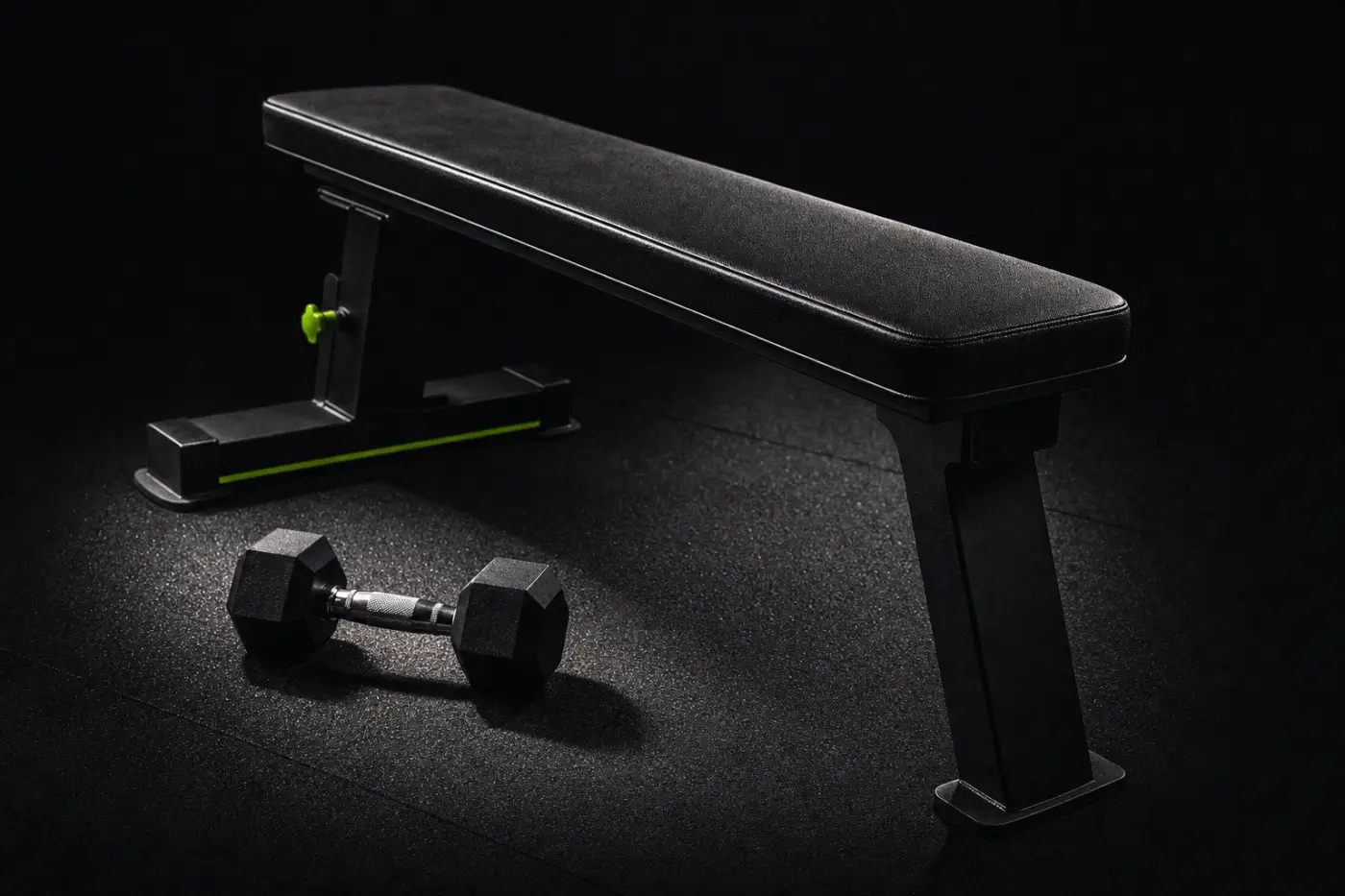
- Adjustable bench — turns dumbbells into a full upper-body gym
- Barbell and plates — when you have outgrown dumbbell loading on squats and hinges
- Squat rack — required once the barbell is heavier than you can clean to your shoulders
- Conditioning equipment — last, because running is free
That order is deliberate. Most people reverse it, buy a treadmill first, and end up with an expensive clothes horse and no way to squat.
Build 1 — Minimum viable
Enough to run a genuine hybrid programme. Fits in a corner.
- Adjustable dumbbells, going as heavy as you can afford
- Doorway or wall-mounted pull-up bar
- A rubber mat
- A jump rope
- A set of resistance bands
What you can train: goblet squats, dumbbell RDLs, split squats, lunges, presses, rows, pull-ups, farmers carries, loaded step-ups. That is a complete strength programme for a hybrid athlete, and it will carry you a long way.
The limit: you will eventually outgrow dumbbell loading on squats and deadlifts. Everyone does. That is the signal to move to Build 2, and it is usually a year or two away.
Build 2 — Serious
The one most people should end up at.
Everything above, plus:
- Barbell — a proper 20 kg bar, not a cheap flexible one
- Bumper plates, enough to reach roughly 1.5× bodyweight
- Squat rack or half rack with safety arms
- Adjustable bench
- Rubber flooring under the lifting area
What you can train: essentially everything strength-related. Squats, deadlifts, presses, rows, all of it, loaded properly and progressed for years.
A note on safety arms: if you train alone, they are not optional. They are the difference between a failed rep and an emergency.
Build 3 — No compromise
Everything above, plus, in order of usefulness:
- A rowing machine — the single best conditioning purchase. Low impact, full body, and directly transferable to HYROX
- Kettlebells — 16, 24 and 32 kg covers swings, carries, and complexes
- A weighted vest — for carries and running
- Sandbag — the closest home substitute for HYROX sandbag work
- A dip station or rings
- A treadmill or bike, if weather genuinely stops you training outdoors
What is usually not worth the money
Cable machines and multi-gyms. Enormous footprint, high cost, and they replicate work that free weights do better.
Most machines generally. They remove the stabilisation demand that a hybrid athlete specifically needs.
Fixed dumbbell sets. Ten times the space and cost of adjustables for the same function.
Cheap barbells. A flexible, poorly-knurled bar makes every session worse and will not take real load. This is the one place not to save money.
A treadmill, early. Running outside is free. Buy this last, if at all.
"Toning" equipment, vibrating plates, ab machines. See fitness myths that refuse to die.
What you cannot replicate
Be honest about this, especially for HYROX.
A sled needs a sled and a surface. A SkiErg has no true substitute. Neither does a competition wall ball target.
You can approximate the demands:
- Sled push → heavy incline treadmill walking at high resistance, heavy leg press, weighted sled drags if any surface allows
- Sled pull → heavy horizontal rows for volume, band or cable pulls
- SkiErg → rowing for the energy system, straight-arm band pulldowns for the pattern
- Wall balls → dumbbell thrusters or squat-to-press
- Sandbag lunges → weighted vest or dumbbell walking lunges
But approximations are not the thing. If you are racing, get to a HYROX-equipped gym for at least a few sessions in the block — the implements are heavier and more technical than they look, and race day is a terrible time to meet them. That is a core point of the 12-week first-timer plan.
Two practical notes
Floor protection is not optional. Dropping a loaded barbell onto a domestic floor damages the floor, the plates, and your relationship with anyone below you. Rubber matting under the lifting area, always.
Ceiling height. Measure before you buy a rack. Overhead pressing and pull-ups both need more clearance than people expect, and this is the constraint that most often ruins a home gym plan after the money is spent.
The actual value
A home gym does not make you train better. It makes you train more, by removing the travel, the packing, the parking and the negotiation with yourself — and every one of those is a place where adherence leaks, as covered in what the data says about who sticks with training.
The fifteen-minute session you would never have driven to is the entire return on investment. Buy accordingly: prioritise the things that let you start training within sixty seconds of deciding to.
Questions people ask
What equipment do you need for a home gym?
A minimum viable hybrid setup is adjustable dumbbells, a pull-up bar, a rubber mat, a jump rope and resistance bands. That covers goblet squats, RDLs, split squats, lunges, presses, rows, pull-ups and carries — a complete strength programme for a hybrid athlete.
Can you train for HYROX at home?
Most of it, but not all. A sled, a SkiErg and a competition wall ball target have no true home substitute. You can approximate the demands with heavy incline treadmill walking, rowing and dumbbell thrusters, but if you are racing, get to a HYROX-equipped gym for at least a few sessions — the implements are heavier and more technical than they look.
Are adjustable dumbbells worth it?
They are the highest-value purchase in home training. A single pair covers more of a hybrid programme than any other item, and they take roughly a tenth of the space and cost of an equivalent fixed dumbbell set.
What is the first thing to buy for a home gym?
Adjustable dumbbells, going as heavy as you can afford. Most people reverse the order and buy a treadmill first, which leaves them with an expensive clothes horse and no way to squat.
Do you need a squat rack at home?
Only once the barbell is heavier than you can clean to your shoulders. If you do buy one, get safety arms — training alone without them is the difference between a failed rep and an emergency. Measure your ceiling height before buying, since overhead pressing and pull-ups need more clearance than people expect.
Keep reading
Bulgarian Split Squats: Why They Hurt So Much and Why You Should Do Them
The most hated accessory in strength training is also one of the highest-return exercises for anyone who runs. What makes them disproportionately brutal, how to set up so you train the right thing, and how to program them without wrecking your week.
Grip Strength: The Silent Limiter in Every Hybrid Race
Your farmers carry does not end because your legs quit. Grip is the most trainable and most neglected quality in hybrid sport — and it correlates with a surprising amount beyond the gym.
Progressive Overload When You Can Only Train 3 Days a Week
Adding weight to the bar every week stops working within months. Six other ways to progress, ranked by how long each keeps delivering, built specifically for people whose training frequency is fixed and low.