Iron, Vitamin D and B12: The Bloodwork Athletes Should Actually Check
Persistent fatigue gets blamed on training far more often than it should. The handful of markers genuinely worth testing for endurance athletes, why ferritin matters more than haemoglobin, and when to stop guessing and get bloods.
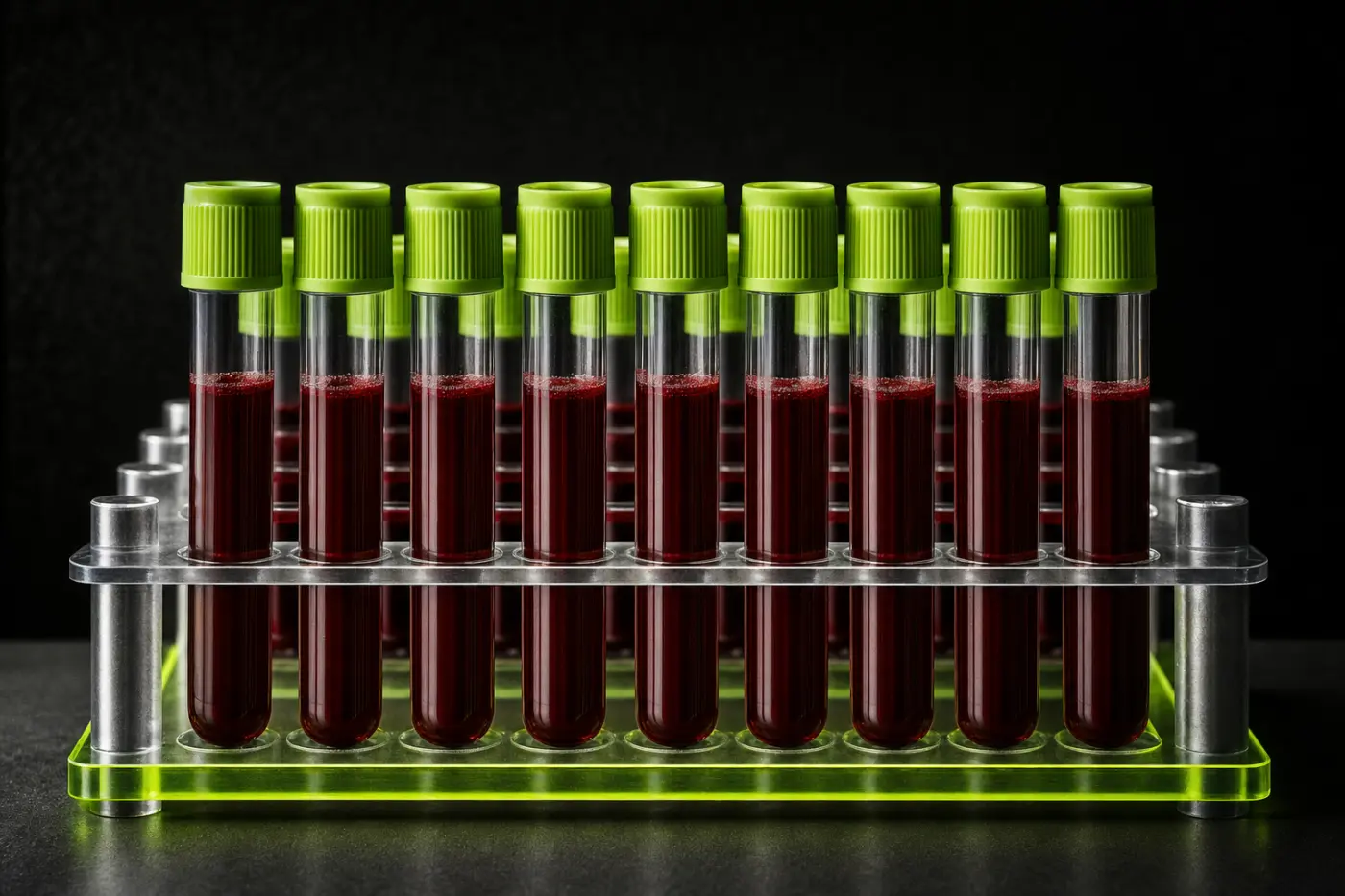
- Ferritin can be low while haemoglobin is normal — and performance suffers first.
- Unexplained fatigue in an endurance athlete deserves a blood test before a deload.
- Iron deficiency is markedly more common in menstruating and vegetarian athletes.
- Do not supplement iron without testing. Excess iron is genuinely harmful.
- Vitamin D and B12 are cheap to check and easy to correct.
There is a pattern that plays out constantly among endurance athletes, and it costs people entire seasons.
Training gets harder. Familiar paces feel wrong. Heart rate sits higher than it should. Recovery between sessions stops working. So you do the sensible thing — deload, sleep more, eat more, back off the volume — and it does not help. Then you conclude you are overtrained, or getting older, or that the programme is wrong.
Sometimes it is none of those. Sometimes it is a blood test.
The one that matters most: ferritin
Iron deficiency is the most common nutritional deficiency worldwide, it is markedly more common in endurance athletes, and its symptoms are almost perfectly disguised as overtraining.
Why athletes lose iron faster
Several mechanisms stack:
- Foot-strike haemolysis — repeated impact damages red blood cells in the feet. Real, and it accumulates over high running volume
- Sweat losses, small per session but not trivial across a heavy training week in heat
- Gastrointestinal losses, which increase with hard endurance training
- Menstrual losses, which is why iron deficiency is substantially more common in menstruating athletes
- Reduced absorption after hard exercise, driven by a hormone called hepcidin that rises with training-induced inflammation and temporarily blocks iron uptake
That last one is a genuinely awkward mechanism: training itself makes iron harder to absorb, for hours afterwards.
Why haemoglobin is not enough
This is the single most useful thing in this article.
Iron depletes in stages. Stored iron goes first — that is ferritin. Only once stores are exhausted does haemoglobin start to fall, which is the point at which you are formally anaemic.
Performance is affected in the first stage. Iron is not only in haemoglobin; it is central to the mitochondrial machinery that produces aerobic energy. An athlete with depleted stores and normal haemoglobin can have measurably impaired endurance capacity.
Which means the common experience of being told "your bloods are normal" is frequently a haemoglobin result, when the relevant number was never checked. Ask for ferritin specifically.
The reference ranges on lab reports are population ranges and their lower bounds are set for the general population, not for endurance athletes. Many sports medicine practitioners work with higher thresholds for athletes. What counts as adequate for you is a conversation with a doctor who knows you train — but you cannot have that conversation without the number.
One important caveat: ferritin is an acute-phase reactant, meaning it rises with inflammation and infection. A test taken shortly after a hard session or during illness can read misleadingly high. Test rested, ideally not within a day or two of a hard workout.
Vitamin D
Widely deficient, particularly in people who train indoors, live at higher latitudes, cover up in the sun, or have darker skin.
Why it matters for athletes: bone health primarily, with roles in muscle function and immune function. Low status is associated with higher stress fracture risk, which is the injury that ends seasons rather than weeks.
Worth knowing: the supplementation literature is less impressive than the deficiency literature. Correcting a genuine deficiency helps. Supplementing when already sufficient does not appear to improve performance. This is the standard shape for micronutrients — fixing a deficit works, topping up does not.
Cheap to test, cheap to correct.
Vitamin B12
Most relevant if you are vegetarian or vegan. B12 occurs naturally in meaningful amounts almost exclusively in animal products, and deficiency produces fatigue, poor concentration and, if prolonged, neurological problems.
Vegans should supplement B12 as a matter of course rather than testing and hoping. Vegetarians who eat dairy and eggs are usually adequate but not reliably so, and are worth testing. The wider picture for plant-based athletes is in the vegetarian hybrid athlete.
The rest of a sensible panel
Full blood count. Catches anaemia, gives red and white cell picture, and is bundled with almost every test anyway.
Thyroid function. Worth including when fatigue is persistent and unexplained, since an underactive thyroid produces exactly the symptom picture of chronic under-recovery.
Basic metabolic panel — kidney and liver function, electrolytes. Broad, cheap, and occasionally catches something unrelated.
Hormonal markers, if the cycle has become irregular or absent, or in male athletes with persistent fatigue and loss of drive at high training volumes. Both can indicate low energy availability, which is a serious finding rather than a training quirk — see the discussion in training through the menstrual cycle.
That is the whole list. The expansive athlete panels sold direct-to-consumer add dozens of markers with no established action attached to them, and the main outcome is anxiety about numbers nobody knows how to interpret.
When to test
Test if:
- Fatigue has persisted for more than two or three weeks despite genuine rest
- Familiar paces feel disproportionately hard, or your heart rate at those paces has climbed
- You are a menstruating endurance athlete, especially with heavy bleeding
- You are vegetarian or vegan and training seriously
- You are training at high volume and something feels off
- You have been recovering poorly for a while and cannot explain why
Do not test:
- Reflexively, every eight weeks, chasing optimisation
- Immediately after a hard session or during illness, when several markers are distorted
- Instead of addressing sleep and food, which are more likely to be the problem than any deficiency
The thing not to do
Do not supplement iron without testing.
Iron is one of the genuinely dangerous nutrients to take unnecessarily. The body has no efficient mechanism for excreting excess, and iron overload causes real organ damage. A meaningful minority of people carry a genetic predisposition to accumulate it.
There is also a large group of athletes taking iron because a forum suggested it, with no test, no follow-up, and gastrointestinal side effects they have accepted as normal. If a test shows depletion, correct it under medical guidance — including the practical detail of when and how to take it, since absorption is affected by timing relative to training, coffee, tea and calcium.
This is the exception to the general principle in the four supplements with actual evidence: most supplements are wasted money, and iron is one where being wrong is worse than wasted.
The summary
If you are inexplicably tired and training is going backwards, the reflex is to change the training. Sometimes the answer is a ferritin result and eight weeks of correction.
Ask for ferritin, not just haemoglobin. Add vitamin D and B12. Test rested. Take the results to a doctor rather than a forum, and do not supplement iron on a hunch.
It is an inexpensive test that occasionally explains an entire lost season — and it is the first thing worth ruling out before concluding that your body has simply stopped responding to training.
Questions people ask
What blood tests should athletes get?
A full blood count, ferritin, vitamin D and B12 cover most of what is both common and consequential. Depending on symptoms and diet, thyroid function and a basic metabolic panel are reasonable additions. This is a small, inexpensive panel that a GP can order and that answers most cases of unexplained training fatigue.
Why is ferritin more important than haemoglobin for athletes?
Ferritin reflects stored iron, and stores deplete well before haemoglobin falls. That means an athlete can have entirely normal haemoglobin, be told their bloods are fine, and still be functionally iron deficient with measurably impaired endurance performance. Ferritin catches the problem at the stage where it is affecting training.
What are the symptoms of low iron in runners?
Unexplained fatigue, heavy legs, a higher heart rate than usual at familiar paces, breathlessness on efforts that used to be comfortable, poor recovery between sessions, and a general sense that training has become harder without an obvious cause. These overlap almost entirely with overtraining, which is why iron deficiency is so often missed.
Should athletes take iron supplements?
Only after testing. Iron is one of the few nutrients where excess causes real harm, since the body has no efficient way to excrete it, and unnecessary supplementation carries genuine risk. If a test shows depletion, supplementation should be guided by a doctor, including how to take it for best absorption.
How often should athletes get blood tests?
Once a year is reasonable for most trained athletes as a baseline, and more often if you are correcting a deficiency, are a menstruating endurance athlete, follow a vegan diet, or are training at high volume. Outside those cases, testing is best triggered by symptoms rather than done routinely.
Keep reading
Alcohol and Training: What One Night Actually Costs
The effects on sleep architecture, protein synthesis, hydration and next-day performance, with the honest magnitudes attached. What a couple of drinks costs versus a heavy night, and how to time it around a training week.
Caffeine for Athletes: Dose, Timing and the Tolerance Problem
One of the few supplements with genuinely strong evidence, and one most people take in a way that blunts it. Effective dosing by bodyweight, timing before a session, whether to cycle off, and what it costs your sleep.

Electrolytes and Hydration: How Much Salt Do You Actually Lose?
Sweat rates vary five-fold between athletes and sodium concentration varies even more. How to measure your own instead of guessing, what the numbers mean for a hot-weather session, and why most electrolyte tabs are underdosed.