WHOOP vs. Oura vs. Garmin vs. Apple Watch: Which Should a Hybrid Athlete Wear?
Four devices measuring overlapping things with very different philosophies. What each is genuinely best at, where each is weakest, and a straight recommendation depending on whether you care more about the run or the recovery.
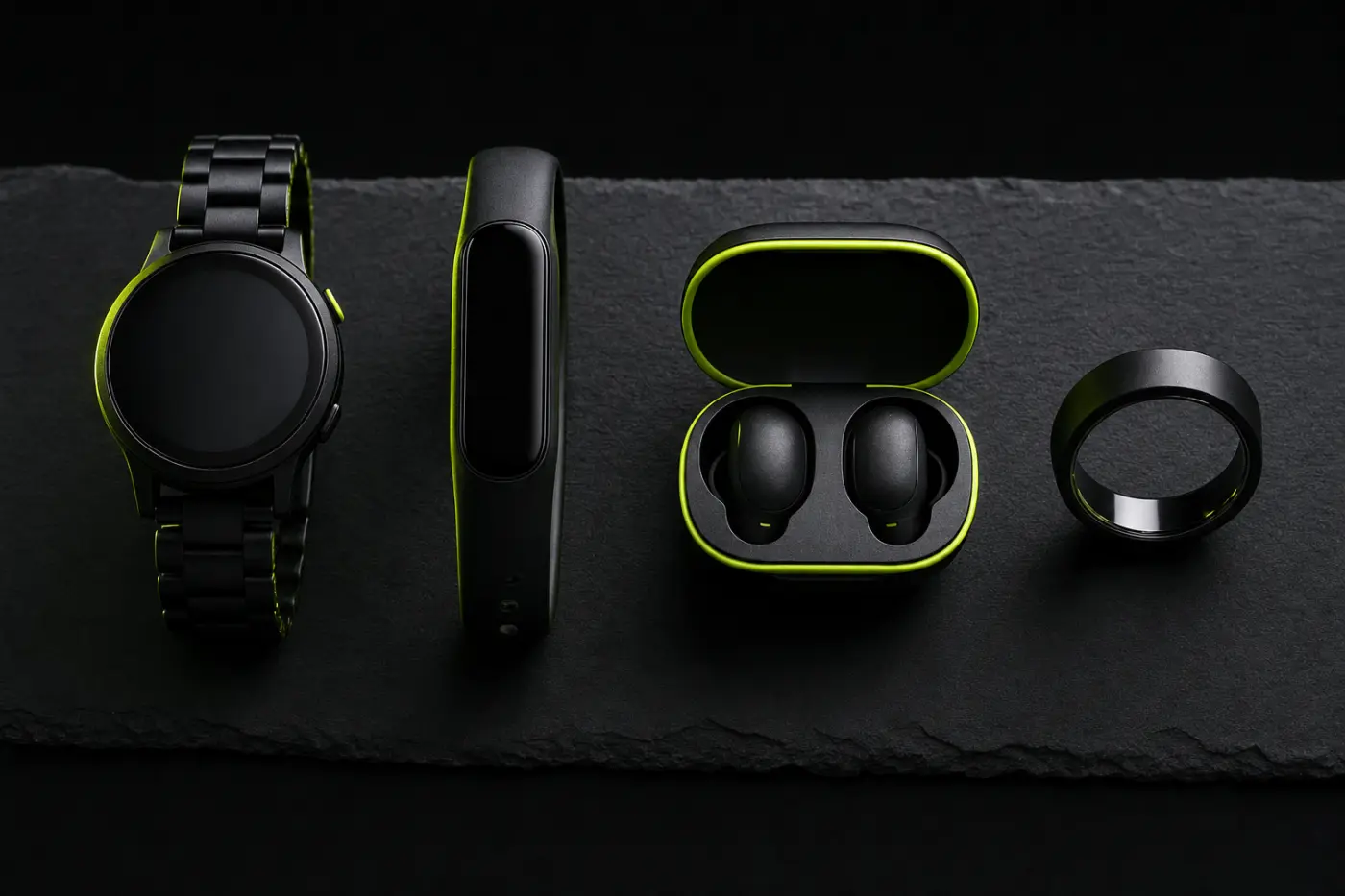
- Garmin is the only one of the four built primarily around the run — if pace, GPS and route data are the priority, it wins outright.
- Oura is the best pure sleep and recovery instrument, and the only one you will actually wear every night without noticing.
- WHOOP is the strongest coaching layer around strain and recovery, but it is subscription-only and has no screen.
- Apple Watch is the best all-rounder and by far the best-integrated, at the cost of daily charging.
- The device matters far less than whether anything acts on the data. Most people buy a very good sensor and then ignore it.
Four devices, four philosophies, and a great deal of overlapping marketing. Stripped of that, the honest comparison is fairly simple — each of these is genuinely best at one thing and compromised at another, and which compromise you accept depends on what you actually train.
One caveat up front: hardware and features on all four move every year. What follows is about the design philosophy of each product, which changes far more slowly than the spec sheet.
The one-line version
| Device | Best at | Weakest at | Buy it if |
|---|---|---|---|
| Garmin | Running and outdoor data | Comfort in bed, sleep nuance | The session is what you care about |
| Oura | Sleep and recovery | Anything during a workout | You want the truth about your nights |
| WHOOP | Strain and recovery coaching | No screen, subscription-only | You want to be told how hard to go |
| Apple Watch | Everything, adequately | Battery, multi-day wear | You want one device and an ecosystem |
Garmin — the athlete's instrument
Garmin is the only one of the four designed from the run outward rather than from wellness inward.
What it does better than the others: GPS accuracy, particularly on multi-band models in cities and under trees. Running dynamics. Route navigation. Battery that lasts a week of training or a hundred-mile race. And the deepest native training-load model of the four — training status, acute and chronic load, and race predictions that are usually within a plausible range.
Where it falls down: it is a watch, and a fairly large one. Wearing it in bed is a compromise most people make grudgingly, and wrist-based overnight HRV is the noisiest of the four measurement approaches. Garmin's sleep analysis has improved considerably but is still not why anyone buys one.
Buy it if your training is meaningfully outdoors and pace matters. For anyone racing HYROX, marathons or triathlon, this is the default and everything else is an addition to it.
Oura — the sleep instrument
A ring is a fundamentally better form factor for continuous physiological measurement than a watch, for two boring reasons: the finger has better perfusion for optical sensing than the wrist, and you forget you are wearing it.
What it does better: sleep staging and sleep quality, overnight HRV stability, resting heart rate trend, and body temperature deviation — which is often the earliest available signal of an oncoming illness. Battery lasts about a week. It is the only one of these four you will genuinely wear every single night for a year.
Where it falls down: it is close to useless during a workout. No GPS, no meaningful exercise heart rate, and you will take it off to lift anything with a barbell. It measures your recovery beautifully and your training barely at all.
Buy it if your training data is already handled and recovery is the gap. It pairs naturally with a Garmin.
WHOOP — the coach
WHOOP's proposition is different from the other three: it is less a sensor and more an opinion. Everything is framed around a daily strain target and a recovery percentage, and the product is constantly telling you whether to push or back off.
What it does better: the coaching layer, genuinely. Of the four, it does the most to turn physiological data into a training instruction. The upper-arm strap option gives more stable readings than any wrist device. No screen means no notifications, which some people find is the entire point.
Where it falls down: subscription-only, so the total cost over three years is substantial. No screen also means no in-session feedback without your phone. And the strain model is a proprietary number that does not translate cleanly to anything else, which makes it awkward as a source of truth alongside another platform.
Buy it if you want the decision made for you and will actually follow it.
Apple Watch — the all-rounder
If you have an iPhone, the Apple Watch is the path of least resistance, and that counts for more than enthusiasts admit.
What it does better: integration. Everything writes to HealthKit, which means the widest possible range of third-party apps can read your data and do something with it. Workout tracking is good across a broad range of activities. It handles the non-training half of your life — messages, payments, alarms — which is why it stays on your wrist when a dedicated tracker would come off.
Where it falls down: battery. Charging daily means either sleeping without it or charging at an awkward time, and sleep data is where a lot of the recovery signal lives. Native recovery interpretation is also lighter than WHOOP's or Oura's — the data is there, but Apple is more restrained about telling you what it means.
Buy it if you want one device and you want your data to be portable to whatever you use to actually act on it.
What actually matters
Here is the uncomfortable part, and it applies regardless of which one you buy.
None of these four change your training on their own. They measure, they score, and then they present you with a number and a decision at 6am. The performance benefit does not come from the sensor. It comes from something acting on what the sensor found — a lower-intensity session on a bad recovery week, a harder one when readiness is high, a calorie target that knows you ran 18 km yesterday.
Most people buy a very good sensor and then ignore it for eleven months, which is an expensive way to learn that data is not the bottleneck.
Whatever you wear, make sure something downstream is reading it. OnlyGains connects to Apple Health — which covers Apple Watch and, via its own app, Garmin — plus Strava, Oura, WHOOP and Fitbit directly, and uses readiness as an input to the next day's plan rather than as a notification.
The recommendation
- Racing anything with a distance in the name: Garmin. Add Oura if you can afford both.
- Training seriously but indoors and unstructured: WHOOP, for the coaching.
- Already own an iPhone, want one device: Apple Watch, and pair it with something that interprets the data.
- Sleep is your known weak point: Oura, and it is not close.
And if you own one already: keep it. The upgrade that will actually move your training is not a better sensor.
Questions people ask
Which fitness tracker is most accurate?
For heart rate during hard intervals, a chest strap beats all four wrist and finger devices, and it is not close. For overnight resting metrics like HRV and resting heart rate, finger-worn Oura and upper-arm WHOOP placement are generally more stable than a wrist watch. For GPS pace and distance, Garmin's multi-band models lead.
Is WHOOP better than Oura for athletes?
WHOOP is more oriented to training: it quantifies daily strain and frames recovery in terms of how hard you should go. Oura is the better sleep instrument and far more comfortable to wear continuously. If you want a coaching layer, WHOOP. If you want the cleanest recovery data with the least friction, Oura.
Can you wear a WHOOP and a Garmin together?
Yes, and a lot of serious athletes do exactly that — Garmin on the wrist for the session, WHOOP or Oura for continuous recovery. The main cost is duplicated data, so decide which one is the source of truth for training load before you end up reconciling two contradictory numbers.
Does Apple Watch track recovery?
It records the underlying inputs — overnight HRV, resting heart rate, sleep stages, wrist temperature — but Apple's native presentation is lighter on interpretation than WHOOP's or Oura's. Third-party apps reading from HealthKit are generally where that data becomes an actual recommendation.
Which wearable is best for running data?
Garmin, comfortably. Multi-band GPS accuracy, running dynamics, long battery life for ultra distances, and the deepest native training-load analysis of the four. Apple Watch Ultra closes much of the gap; the standard Apple Watch does not.
Keep reading
Deload Weeks: How to Know When You Need One (And What to Actually Do)
A deload is not a week off, and 'every fourth week' is not a plan. The specific signals that mean your body is asking for one, and three deload protocols matched to what is actually fatigued.
HRV, Explained Without the Hype: What Your Score Is Actually Telling You
Heart rate variability is a genuinely useful signal wrapped in a lot of marketing. What it measures, why absolute numbers are meaningless between people, and the only way to read yours that holds up.
Ice Baths and Sauna: What the Evidence Says for Strength and Endurance
Cold plunging after lifting appears to blunt the exact adaptation you trained for. Heat exposure appears to do the opposite for endurance. A timing-based guide to using both without cancelling your own work.