Kettlebells for Hybrid Athletes: The Five Movements That Matter
Kettlebells are excellent for conditioning, carries and hinge power, and mediocre for maximal strength. Which five movements earn their place, what weights to buy, and where kettlebell work fits alongside a barbell.
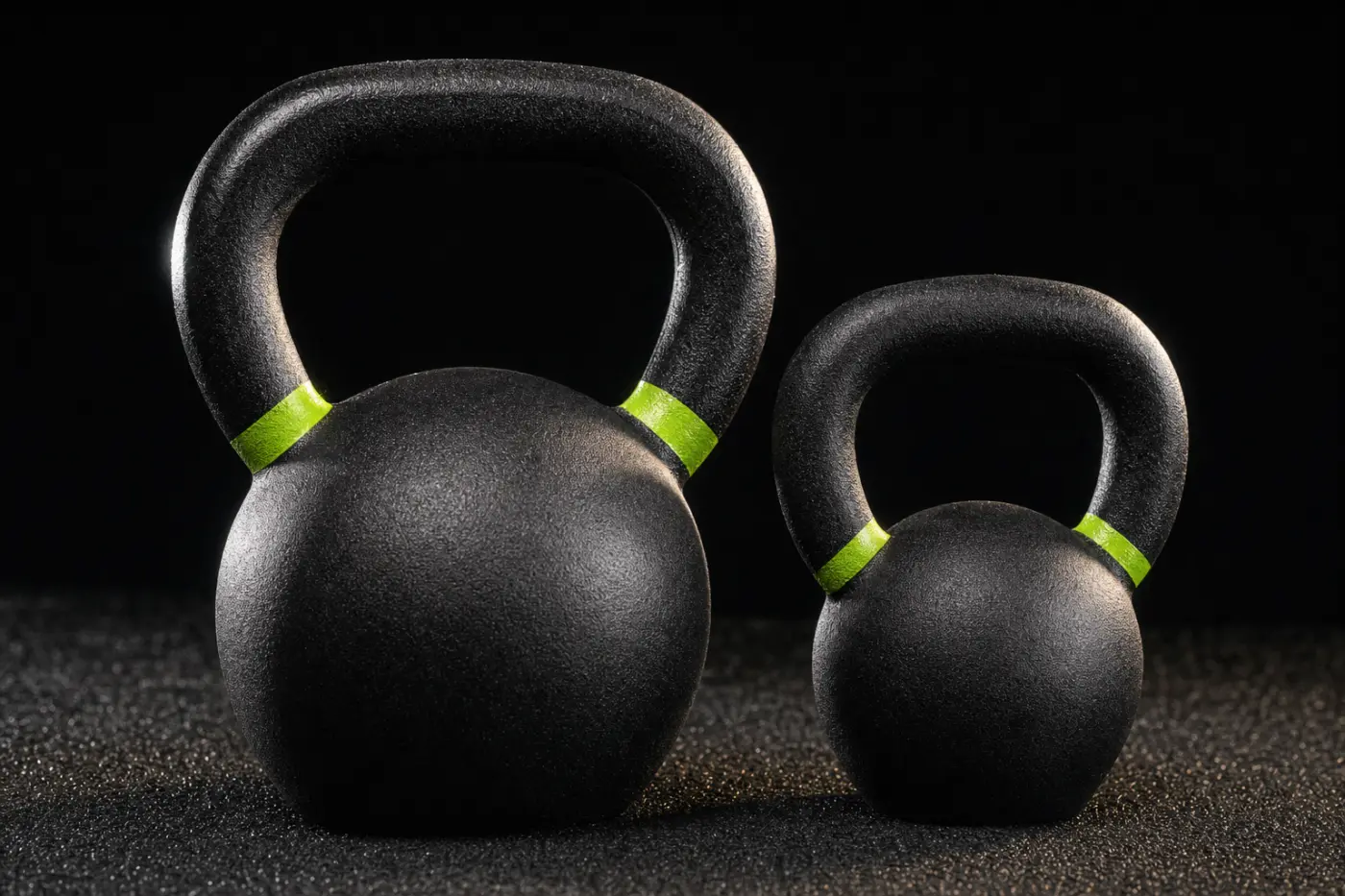
- Kettlebells are a conditioning and power tool, not a maximal strength tool.
- Five movements cover it: swing, goblet squat, front rack carry, press, Turkish get-up.
- The swing is a hinge, not a squat. Most people do it wrong and feel it in their back.
- Two bells — around 16 and 24 kg for most men, 8 and 16 kg for most women — covers nearly everything.
- They complement a barbell. They do not replace one if strength is your goal.
Kettlebells attract two kinds of nonsense: the claim that they replace everything, and the dismissal that they are a gimmick. Both are wrong in the same way, which is by ignoring what the implement is actually good at.
Kettlebells are excellent for ballistic hinge power, loaded carries, overhead stability and conditioning. They are mediocre for maximal strength. Everything below follows from that.
Why the shape matters
The load sits offset from the handle rather than in line with it, which is the entire design difference from a dumbbell.
That offset creates a constant rotational demand — the bell wants to pull away from your grip, and stabilising it trains the shoulder, forearm and trunk in a way a symmetrical implement does not. It also makes the bell comfortable to hold in the front rack position, resting against the forearm, which is why loaded carries and presses feel natural with kettlebells and awkward with dumbbells.
The trade-off is that the same offset makes precise heavy loading impractical. You are not going to squat 140 kg with kettlebells.
The five
1. The swing — the primary movement
What it is: a hip hinge, driven explosively, with the bell travelling on an arc because of hip extension rather than because your arms lifted it.
What it trains: explosive hip extension — the glutes and hamstrings, in a pattern closely related to running propulsion — plus a substantial conditioning effect.
How: 5 sets of 15 to 20, or intervals of 30 seconds on and 30 off. Hinge back, load the hamstrings, snap the hips forward, let the bell float to roughly chest height, guide it back between the legs.
The universal error: squatting the swing. If your knees are travelling forward and the bell drops toward the floor rather than back between your legs, you are squatting it, and you will feel it in your lower back. The bell path should stay high and go backward through the legs, not downward.
Second most common error: lifting the bell with the arms and shoulders. The arms are ropes. The hips do everything.
2. The goblet squat
What it trains: quads and trunk, with the front-loaded position naturally encouraging an upright torso and better depth.
How: hold the bell at the chest, 3 sets of 8 to 12.
Why it earns a place: it is the most self-correcting squat variation available. The counterbalance in front makes it very difficult to squat badly, which makes it excellent for teaching the pattern and perfectly good for training it — the case made in how to build a home gym.
3. The front rack carry
What it trains: trunk, upper back, breathing under load, and grip.
How: one or two bells in the front rack, walk 40 to 60 m, 3 to 4 rounds.
Why it matters for hybrid athletes: this is close to direct HYROX preparation. Carrying load while breathing hard and staying upright is exactly the sandbag and farmers carry demand, and the front rack position is uniquely uncomfortable in a productive way — it forces you to keep the ribs down and breathe against resistance.
4. The overhead press
What it trains: shoulders, with a considerably larger stability demand than a dumbbell press because of the offset load.
How: 3 to 4 sets of 5 to 8 per side.
Why kettlebells specifically: the bell resting on the back of the forearm puts the wrist and shoulder in a naturally stable position, and pressing it overhead requires genuine control throughout. For many people with cranky shoulders, this is the most comfortable pressing variation available.
5. The Turkish get-up
What it trains: everything, slowly. Shoulder stability through full range, trunk control, hip mobility, and a great deal of coordination.
How: 3 to 5 singles per side, light. This is not a conditioning exercise and should never be rushed.
The honest caveat: it takes real time to learn and it is easy to do badly. It is genuinely valuable, and it is also the movement most likely to be skipped by someone with 40 minutes to train. If you drop one of the five, drop this one — but if you have shoulder issues, it is the one to keep.
What to buy
Two bells covers nearly everything.
| Starting bell | Second bell | |
|---|---|---|
| Most men | 16 kg | 24 kg |
| Most women | 8–12 kg | 16 kg |
Add a heavier bell — 32 kg for men, 20 to 24 kg for women — once swings and carries have progressed. Heavy swings are one of the few places where a genuinely heavy bell earns its cost.
Cast iron over adjustable, if space allows. Adjustable kettlebells save room but usually have a thicker handle and a less stable balance, both of which matter more than you would expect.
Where they fit
Kettlebells are not a barbell substitute if strength is your goal. The available loads cap out well below what a trained person can squat and deadlift, and beyond a certain point you simply cannot progress the load. This is the same argument made in progressive overload — if you cannot add weight, you eventually stop adding strength.
Where they are the better choice:
- Conditioning finishers. Swing intervals are among the best low-impact conditioning tools available, and unlike running they cost your legs very little the next day
- Travel and home training. One bell in a hotel room is a complete session
- Carries. The front rack position is genuinely superior to dumbbells
- Deload weeks, where you want movement and load without heavy barbell work
A workable arrangement for someone already lifting: barbell work stays as it is, with 10 to 15 minutes of kettlebell swings and carries appended twice a week as conditioning and posterior chain work.
A sample session
If kettlebells are all you have:
- Goblet squat 3 × 10
- Swing 5 × 15, 45 seconds rest
- Overhead press 3 × 6 per side
- Front rack carry 3 × 50 m
- Get-up 3 singles per side
Thirty-five minutes, one or two bells, no rack, no bench, no bar. That is a genuinely complete session, and it is why kettlebells remain the best single purchase for someone with a corner of a room and no plans to build a gym.
Questions people ask
Are kettlebells good for hybrid training?
Very — they cover conditioning, hinge power, loaded carries and overhead stability in one implement, and they take almost no space. Their limitation is maximal strength: the weights available top out well below what you can squat or deadlift, so they complement a barbell rather than replacing one.
What weight kettlebell should I start with?
For most men, 16 kg is a sensible first bell, adding a 24 kg as swings and carries progress. For most women, 8 to 12 kg to start, adding a 16 kg. Two bells covering a light and a heavy option handle nearly everything worth doing.
Are kettlebell swings good for runners?
Yes. The swing is a hip hinge driven by explosive hip extension, which trains the glutes and hamstrings in a pattern closely related to running propulsion, at low impact and with a strong conditioning element. It is one of the better single exercises a runner can add.
Can you build strength with only kettlebells?
Up to a point, and that point arrives sooner than with a barbell. Kettlebells build genuine strength for beginners and intermediates, especially in pressing and unilateral work, but available loads cap what you can do for squats and hinges. For continued maximal strength progress you eventually need heavier implements.
How many kettlebells do you need?
Two is enough for most people — one moderate and one heavy. A third, heavier bell becomes useful for swings and carries as you progress. Adjustable kettlebells exist and save space, though many have a bulkier handle and shifting balance compared with cast iron.
Keep reading
How to Build a Home Gym for Hybrid Training (Three Budgets)
Three complete equipment lists — minimum viable, serious, and no-compromise — with the order to buy things in, the pieces that are almost never worth the money, and what you can genuinely train without.
The Deadlift for Endurance Athletes: How Heavy, How Often
The most useful lift for a runner and the one most likely to wreck a training week if programmed badly. Loading, frequency, which variation to pick, and where to put it so it does not eat your long run.
Bulgarian Split Squats: Why They Hurt So Much and Why You Should Do Them
The most hated accessory in strength training is also one of the highest-return exercises for anyone who runs. What makes them disproportionately brutal, how to set up so you train the right thing, and how to program them without wrecking your week.