The Tabata Protocol Is Not What You Think It Is
The original study used trained cyclists at an intensity most gym classes never approach, for a purpose almost nobody remembers. What the research actually tested, what it found, and why the four-minute workout you have been sold is a different thing entirely.
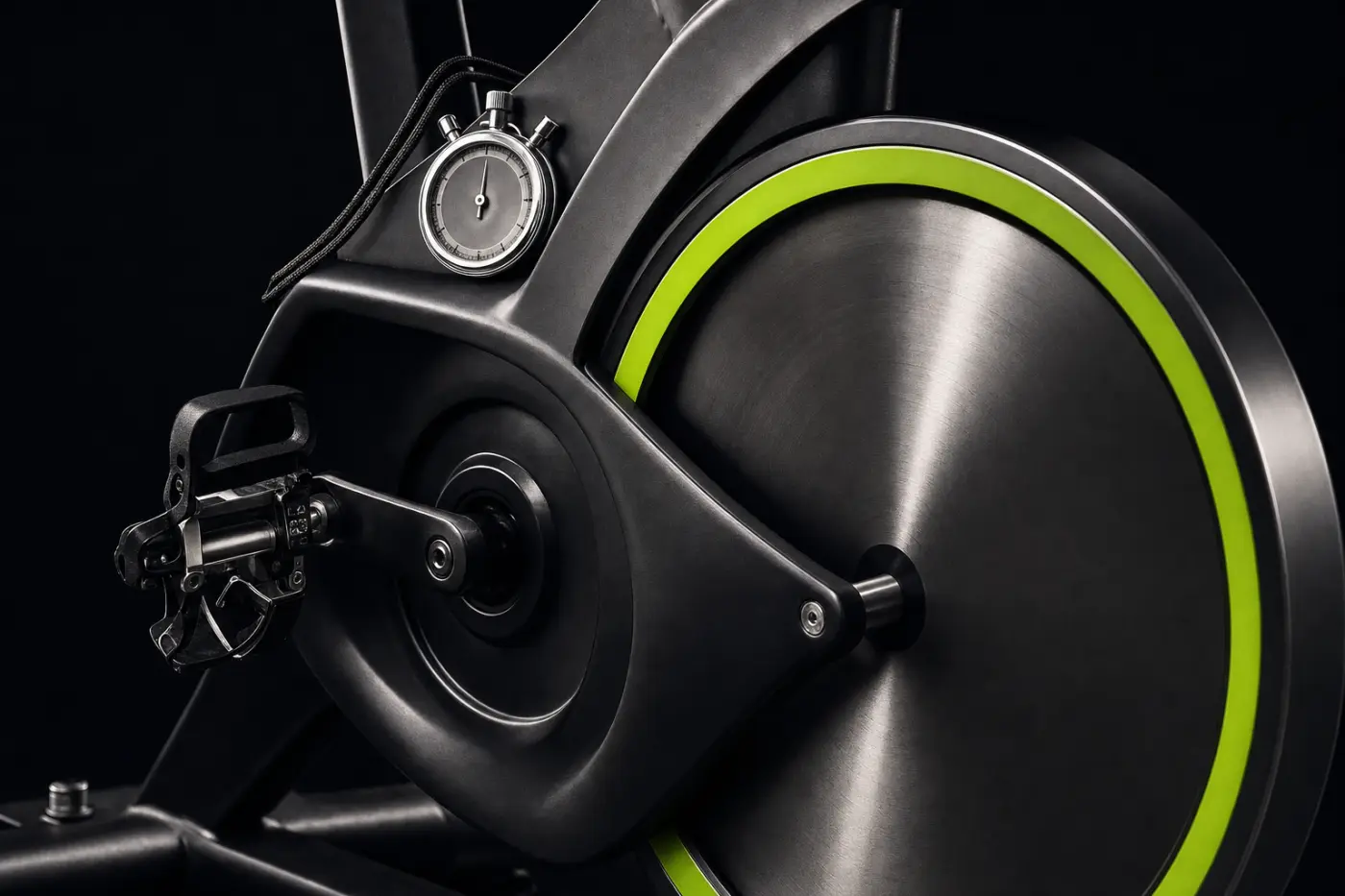
- The original protocol was performed on stationary bikes by trained athletes.
- The intensity was around 170% of VO2 max — far beyond what a bodyweight circuit produces.
- Eight rounds of 20 seconds on, 10 seconds off, and the subjects could barely complete it.
- It was never proposed as a complete training programme or a fat-loss method.
- If you can talk after your 'Tabata' class, you did something else. That is fine — just call it something else.
Walk into most gyms and you will find a Tabata class. Twenty seconds of squat jumps, ten seconds of rest, eight rounds, several exercises, forty minutes, a playlist.
Almost none of that resembles the thing it is named after.
What the study actually did
The protocol comes from research led by Izumi Tabata and colleagues at Japan's National Institute of Fitness and Sports, published in the mid-1990s. The setup was specific in every dimension.
The subjects were trained. Members of a university speed skating team and physically active students — not beginners, and not people encountering hard intervals for the first time.
The mode was a cycle ergometer. A stationary bike, which is the ideal instrument for this because the resistance is precisely controllable and the intensity can be prescribed and verified rather than estimated.
The intensity was around 170% of VO2 max. This is the number that matters and the one that never survives into the gym version. It means an effort far above the intensity at which you reach maximal oxygen uptake — deep into anaerobic territory, at a work rate you cannot hold.
The structure was 20 seconds on, 10 seconds off, eight times. Four minutes total.
The subjects were destroyed by it. Many could not complete all eight rounds at the prescribed work rate. That was expected, and it is a key detail: the protocol was designed so that the final rounds are barely achievable.
What it found
The headline result was that this four-minute protocol, done several times a week alongside other training, improved both aerobic capacity and anaerobic capacity — which was interesting because most interval research at the time showed improvement in one at the expense of attention to the other.
That is a genuine and useful finding. It is also considerably narrower than what the internet did with it.
What it did not find
Worth stating explicitly, since all of these get claimed:
It did not find that four minutes replaces your training. The subjects were doing other training. The protocol was an addition, not a substitute.
It did not test fat loss. Body composition was not what the study was about.
It did not test bodyweight circuits. Burpees, squat jumps and mountain climbers were not involved. The mode was cycling, and mode matters — you cannot reach 170% of VO2 max doing air squats, because the movement itself limits how much power you can produce.
It did not claim to be superior to all other training. It was a comparison of specific protocols under specific conditions.
Why the gym version is different
Take the 20/10 clock and apply it to bodyweight exercises in a class of thirty people of mixed fitness, for forty minutes, and you have changed every variable that made the original work.
The intensity cannot be reached. A squat jump is limited by mechanics, not by your capacity to produce power. You physically cannot generate 170% of VO2 max doing them.
Forty minutes is not four minutes. Once you extend it, you have necessarily reduced the intensity — nobody sustains supramaximal work for forty minutes. So it becomes a moderate-intensity circuit, which is a perfectly reasonable thing, and not this thing.
Fatigue changes the exercise. Complex movements performed at maximum effort while exhausted is how people get hurt. The bike had no such problem: as you fatigue, you simply produce less power.
None of which makes a Tabata-style class bad. Circuit training is a fine way to spend forty minutes. It is just not the protocol, and the name creates a false expectation — that four minutes of this is doing something extraordinary.
The honest test
Here is how to know which one you did:
Could you have done a ninth round? If yes, it was not the protocol.
Could you talk immediately afterwards? If yes, it was not the protocol.
Was your work rate in round eight roughly the same as round one? If yes, you paced it — and pacing is precisely what the protocol forbids. In the original, output was supposed to be unsustainable from the start.
The correct experience of a real Tabata is that rounds one and two feel manageable, round four feels alarming, and rounds six through eight are a genuine struggle to keep the pedals turning.
When to actually use it
It has a real place, with real constraints.
Use it if: you are already aerobically trained, you have a bike or rower where intensity is controllable, you want a short potent stimulus, and you have the recovery capacity to absorb it.
Do it on a bike or a rower, not with bodyweight movements. This is the single most important practical point — you need a mode where you can express maximum power safely while exhausted.
Once a week at most, and not in a week already containing hard intervals. This is a very high-fatigue four minutes, and for a hybrid athlete it competes for the same recovery budget as your lifting.
Never near a race or a heavy session. The cost lands for two days.
Warm up properly first. Ten to fifteen minutes. Going into supramaximal work cold is how people find out about their knees.
For most hybrid athletes, honestly, the answer is that there are better uses of a hard session — threshold work delivers more aerobic return per unit of fatigue, which is the argument made in polarized vs. threshold training. Tabata is a sharp tool for a narrow job.
The wider lesson
This is a case study in what happens to a piece of research when it escapes into marketing.
A specific protocol, tested on specific athletes, on a specific machine, at an intensity almost nobody can reach, became "the four-minute workout" — a claim the study never made and could not support.
The pattern repeats constantly in fitness. A real finding, a narrow context, a headline that drops the context, and eventually a product. It is worth knowing the shape of it, because the next one is already on its way, and the tell is always the same: the intensity, the population and the duration quietly go missing.
Izumi Tabata has spent years pointing out that the thing bearing his name is usually not his protocol. He is right, and it is a slightly unusual form of scientific immortality — being extremely famous for something almost nobody actually does.
Questions people ask
What is the real Tabata protocol?
Eight rounds of 20 seconds of work and 10 seconds of rest, four minutes total, performed on a cycle ergometer at an intensity of roughly 170% of VO2 max. It came from research led by Izumi Tabata published in the mid-1990s, using trained athletes, and the intensity is the defining feature — not the 20/10 timing.
Is Tabata actually effective?
The original protocol was, for the specific thing it was tested on: it improved both aerobic and anaerobic capacity in already-trained subjects in a very short time. What is sold as Tabata in most gyms — bodyweight circuits at moderate intensity on the same clock — is ordinary interval work and does not produce the same result.
How intense should Tabata intervals be?
Genuinely maximal, at an effort you could not sustain for a fifth round without the work rate collapsing. In the original study subjects were exhausted by the end and many could not complete all eight rounds. If you finish able to talk or ready to do another set, the intensity was not close to the protocol.
Is a 4 minute workout enough?
Not as a complete training programme, and it was never proposed as one. Four minutes of maximal interval work is a potent stimulus for specific adaptations, but it does not replace aerobic base work, strength training, or the total weekly volume that drives most fitness outcomes.
What is the difference between Tabata and HIIT?
Tabata is one very specific HIIT protocol — a fixed 20/10 structure for eight rounds at supramaximal intensity. HIIT is the broad category of alternating hard efforts with recovery, covering everything from 30/30s to 4-minute intervals. All Tabata is HIIT; almost no HIIT is Tabata.
Keep reading
The Norwegian Method: How Double Threshold Training Took Over Endurance Sport
Two threshold sessions in one day, lactate meters at the track, and a training philosophy built on doing slightly less than you could. Where the method came from, what it actually prescribes, and the part that does not transfer to amateurs.
VO2 Max: What It Is and How to Actually Raise It
Your watch's estimate, what the number physiologically means, how much of it is trainable versus inherited, and the two session types that move it. Plus the honest answer on how much it matters once you are past beginner.
Bulgarian Split Squats: Why They Hurt So Much and Why You Should Do Them
The most hated accessory in strength training is also one of the highest-return exercises for anyone who runs. What makes them disproportionately brutal, how to set up so you train the right thing, and how to program them without wrecking your week.