Running Economy: The Quality Nobody Trains Directly
Two runners with identical VO2 max can be minutes apart over a half marathon. What running economy is, the four things that reliably improve it, and why heavy lifting shows up on that list ahead of form drills.
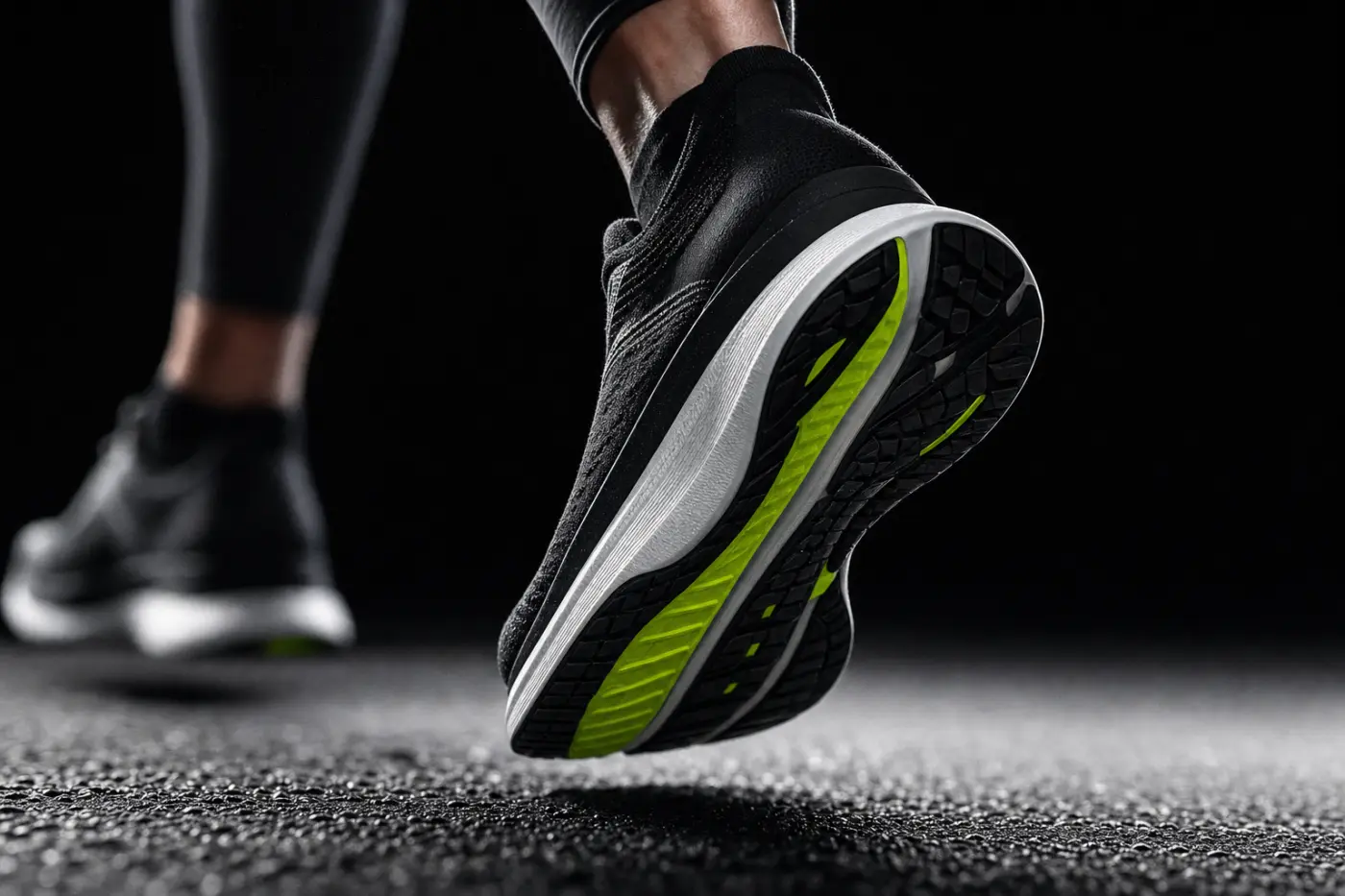
- Economy is how much oxygen a given pace costs you. Lower is better.
- It explains why two runners with the same VO2 max race very differently.
- Heavy strength training is the best-evidenced way to improve it.
- Plyometrics work too, and they are the second thing to add, not the first.
- Form coaching has a much weaker record than most people assume.
VO2 max gets the attention because it is the number on your watch. But if you take two runners with an identical VO2 max and race them over a half marathon, they can finish minutes apart.
The difference is usually economy, and it is the least discussed of the three variables that determine endurance performance.
What it actually is
Running economy is the oxygen cost of running at a given submaximal pace.
If two runners both run 5:00/km, and one consumes less oxygen doing it, that one is more economical. They are producing the same output for less input — which means at any given effort they can go faster, and at any given pace they are working less hard.
The analogy that actually holds is fuel efficiency. VO2 max is the size of the engine. Economy is the litres per hundred kilometres. A large engine in an inefficient car loses to a smaller engine in an efficient one, over a long enough distance.
The three-variable model
Endurance performance rests on:
- VO2 max — your aerobic ceiling
- Fractional utilisation — the percentage of that ceiling you can sustain, essentially your threshold
- Economy — what a given pace costs
Past beginner level, VO2 max is the least trainable of the three. It rises quickly at first and then stubbornly. Threshold and economy keep improving for years.
Which is why experienced runners continue to get faster while their VO2 max barely moves — and why fixating on the watch's estimate misdirects a lot of training, as argued in VO2 max: what it is and how to actually raise it.
What determines it
Economy is a composite of several things, some trainable and some not.
Trainable:
- Tendon and muscle stiffness. Stiffer tendons store and return more elastic energy per stride — free propulsion you do not have to pay for metabolically
- Neuromuscular coordination. Better inter- and intra-muscular coordination means less wasted activation
- Muscle fibre efficiency, which improves with aerobic training
- Cadence and stride characteristics, at the margins
- Bodyweight, particularly non-functional mass
Largely not trainable:
- Limb proportions and Achilles tendon moment arm
- Body structure generally
- A meaningful genetic component
The honest summary is that some people are born economical. But the trainable portion is large enough to be worth years of attention.
The four things that work
1. Heavy strength training — the best evidenced
This is the intervention with the strongest support, and it consistently surprises runners.
Heavy, low-rep resistance training improves running economy, generally by a few percent, across multiple studies in trained runners. A few percent sounds trivial until you apply it to a half marathon.
The mechanism: increased tendon stiffness improving elastic energy return, better neuromuscular recruitment, and each stride using a lower percentage of your maximum force capacity.
The prescription: heavy — 3 to 6 reps — and low volume, twice a week. Not high-rep circuits, which produce metabolic fatigue and little of the relevant adaptation. The specific programme is in the only six lifts a runner needs.
This is why runners should lift, and it is a better argument than injury prevention because it is a direct performance benefit.
2. Plyometrics — second in line
Jumps, bounds, hops and skips improve reactive strength and tendon stiffness, and the economy improvements in the research are meaningful.
The caveat: they add impact loading on top of running impact. Build a strength base for a few months first, then introduce them gradually — two short sessions a week, low volume, quality over quantity.
Where to start: pogo hops, ankle bounces, low box jumps, skipping. Ten to fifteen minutes appended to a session.
Short hill sprints are a gentler entry point with much of the same benefit, described in hill training.
3. Sheer volume of running
Economy improves with accumulated years and kilometres, largely through neuromuscular refinement — you get better at the specific movement by doing an enormous amount of it.
This is slow and unglamorous and it is why experienced runners are economical. There is no shortcut, and it is one of the better arguments for consistent easy volume over years.
4. Bodyweight, honestly
Carrying less mass costs less oxygen per kilometre. This is straightforward physics.
The nuance is that muscle you need is not a penalty, and losing weight badly — under-fuelling, losing muscle, compromising recovery — makes you slower, not faster. The trade-offs are laid out in how to gain weight without getting slow, and the risks of pursuing it aggressively in the calorie deficit that doesn't kill your training.
What has a weaker record than you think
Form coaching. This is worth being direct about.
Deliberately changing your running form has a considerably weaker evidence base than the marketing suggests. Self-selected form tends to be near-optimal for a given individual — your body has already solved the optimisation problem over many thousands of kilometres. Imposed changes frequently make economy worse in the short term, and often permanently.
The exceptions, where a change is worth making:
- Very low cadence, under roughly 160 spm, where a 5 to 10% increase usually helps
- Severe overstriding, with the foot landing well ahead of the body
- Gross inefficiencies — excessive vertical oscillation, heavy braking
Those are worth addressing. Beyond them, the case for redesigning your stride is thin, and the detail is in cadence, stride and running form.
Barefoot and minimalist running as an economy intervention: the evidence has not supported the strong claims made for it.
Shoes, briefly
Modern carbon-plated racing shoes genuinely do improve running economy, by a margin large enough that the sport had to write rules about them. That is one of the better-supported findings in recent running science.
It is also a purchase rather than an adaptation. Worth knowing; not a training method.
What this means practically
If you want to get faster and you have been doing nothing but running:
- Add two heavy lifting sessions a week. Biggest available return, best evidence
- Keep running consistently, for years
- Add plyometrics after a few months of strength work
- Fix cadence only if yours is genuinely low
- Leave your form alone otherwise
Notice that the highest-value item is not running. For a runner who has never lifted, the fastest available improvement in running performance is in the gym — which is a strange conclusion, well supported, and routinely ignored.
The summary
Economy is what separates runners with the same engine. It is trainable, it improves for years, and the two interventions that move it most are heavy strength work and accumulated volume.
Neither is exciting, and neither involves changing how you run. Which is probably why economy stays the least fashionable of the three variables, despite being the one most likely to be limiting you.
Questions people ask
What is running economy?
The oxygen cost of running at a given submaximal pace. If two runners hold 5:00/km and one uses less oxygen doing it, that runner is more economical — they produce the same output for less input, so at any given effort they can go faster. It is the running equivalent of fuel efficiency, where VO2 max is engine size.
How do you improve running economy?
Four things reliably work: heavy low-rep strength training twice a week, plyometrics once a strength base exists, accumulated years of consistent running volume, and carrying less non-functional mass. Heavy lifting has the strongest evidence and is usually the largest available gain for a runner who has never lifted.
Does strength training improve running economy?
Yes — this is one of the better-supported findings in endurance research, with heavy resistance training improving economy by a few percent in trained runners. The mechanism is increased tendon stiffness returning more elastic energy per stride, plus better neuromuscular recruitment. It requires heavy loads at 3 to 6 reps, not high-rep circuits.
Do carbon plated shoes improve economy?
Yes, by a margin large enough that governing bodies wrote rules about them. The effect is genuine and well documented. It is worth understanding that this is a purchase rather than an adaptation — the shoes improve your economy while you wear them, and change nothing about your underlying fitness.
Is running economy more important than VO2 max?
Past beginner level, usually yes. VO2 max rises quickly in early training and then becomes stubborn, while economy and threshold keep improving for years. This is why experienced runners keep getting faster with a largely unchanged VO2 max, and why fixating on a watch's VO2 max estimate tends to misdirect training.
Keep reading

Hill Training: The Cheapest Speed Work There Is
Hills build strength, running economy and top-end power at a lower injury cost than flat speed work. Four session formats, the gradient that suits each, and how to run downhill without paying for it the next week.

Cadence, Stride and Running Form: What's Worth Changing
Most form advice is cosmetic. Two variables genuinely change your injury risk and economy, and the rest is largely self-organising. What to cue, what to leave alone, and how long a real change takes to stick.

Treadmill vs. Outdoor Running: What Actually Transfers
Treadmill running is not cheating, but it is not identical either. The measurable differences in mechanics, effort and pace, the incline setting that closes most of the gap, and when the treadmill is genuinely the better choice.