The SkiErg and Rower: A Technique Guide for People Who Lift
Strong athletes are routinely slow on both machines because they muscle them. The sequencing that makes each efficient, damper and drag factor settings that actually matter, and the pacing that keeps your legs for the next run.
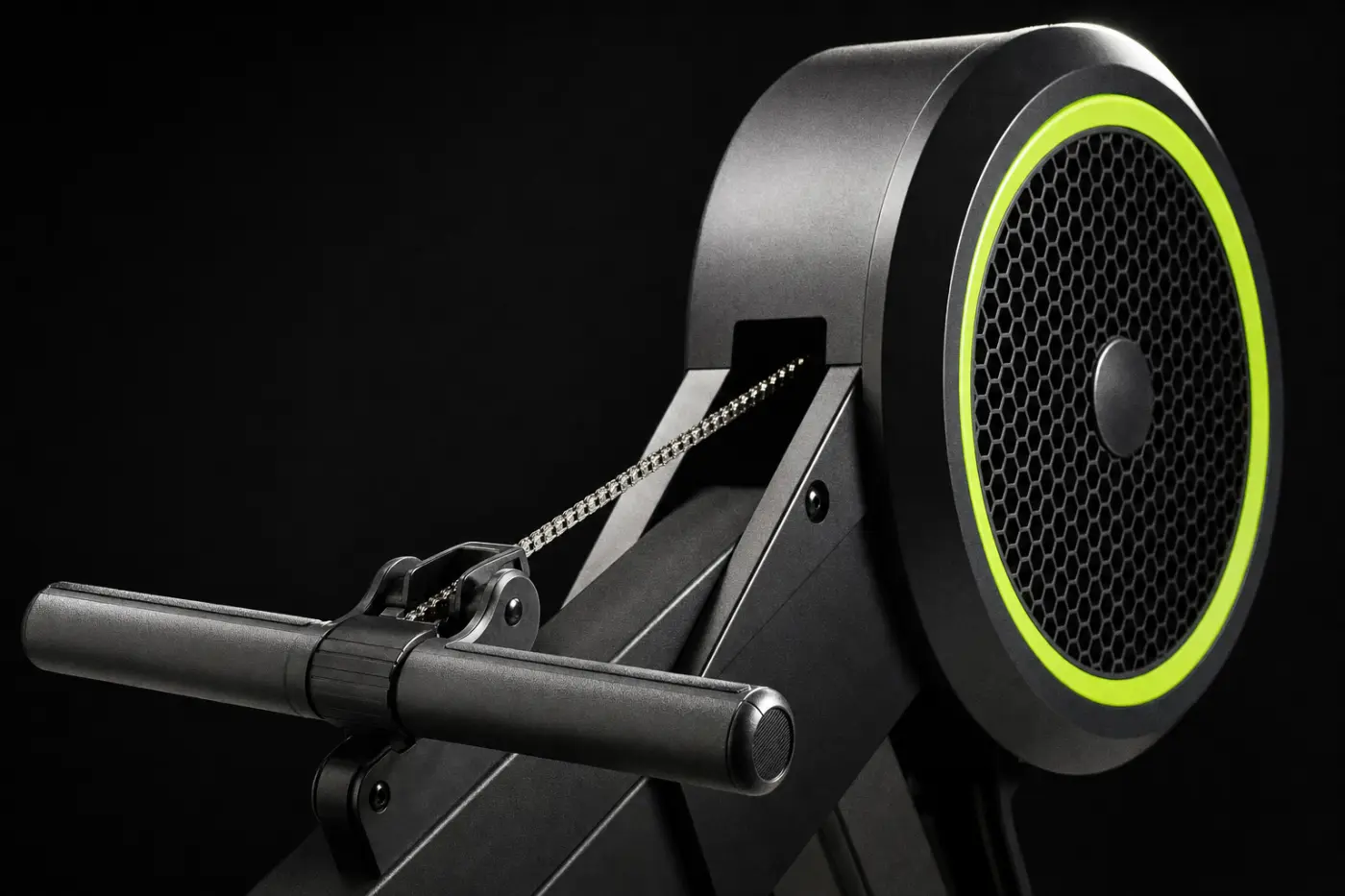
- Both machines are leg-driven. Strong upper bodies mask bad technique and then fail.
- Rowing sequence: legs, then body, then arms. Reverse it on the recovery.
- SkiErg is a hinge, not a lat pulldown. Drive with hips and trunk.
- Damper is not resistance. Drag factor is the number that matters.
- Pace both conservatively — they come early and your legs are needed later.
Two machines, both early in a HYROX race, both with the same failure mode: strong athletes producing mediocre splits and destroying their legs in the process.
The reason is consistent. Both machines look like upper-body work and both are primarily leg-driven, and someone with a strong upper body can mask that for about ninety seconds before the wheels come off.
The rower
The number that matters
Rowing is roughly sixty percent legs, twenty percent trunk, twenty percent arms.
Most people row the reverse. They sit down, grab the handle, and pull. It works briefly, because arms and lats are strong enough to move the handle, and then those relatively small muscles fatigue and the split falls apart.
The sequence
The drive: legs → body → arms.
- Legs. From the catch, press the footplate away with everything. Arms straight, back braced, body angle unchanged. This is where the power is
- Body. As the legs approach extension, swing the trunk back from the hips through roughly vertical to slightly past it
- Arms. Only now do the arms pull, finishing at the lower ribs
The recovery: arms → body → legs. Exactly reversed.
- Arms extend away first
- Body hinges forward from the hips
- Legs bend, sliding you up to the catch
The commonest error: opening the body and bending the arms early, so the legs and back fight each other and the legs never fully contribute.
Rhythm
The drive is fast. The recovery is slow. Roughly one to two, drive to recovery.
Rushing the slide up to the catch is the second commonest error. It spikes your heart rate, shortens the stroke and produces a frantic, inefficient rhythm. The recovery is where you breathe.
Stroke rate: for steady work, 22 to 26 strokes per minute is a sensible band. Very high rates with a weak drive move the handle a great deal and the boat very little.
Damper and drag factor
Widely misunderstood and worth getting right.
The damper is not a resistance setting. It controls how much air enters the flywheel housing, which changes the feel of the stroke — how much like a heavy boat versus a light one.
Drag factor is the real number. It is a machine-measured value found in the monitor's menu, and unlike the damper number it accounts for how dusty the flywheel is. A damper of 5 on a filthy machine can produce a very different drag factor from a damper of 5 on a clean one.
Practical settings: most athletes do best at a damper of 3 to 5, which on a well-maintained machine is a drag factor of roughly 110 to 130.
Damper 10 is not harder in a useful way. It makes each stroke heavy and slow, which usually reduces your rate and your split. Strong athletes gravitate to it because it feels like lifting, and it is generally a mistake.
The SkiErg
Different machine, same underlying error.
It is a hinge
The SkiErg is a hip hinge with an arm finish. It is not a lat pulldown performed standing up.
The sequence:
- Reach tall. Arms high, up on the toes slightly, body extended, handles above head height
- Drive down by hinging hard at the hips — chest dropping, hips travelling back — while the arms pull the handles down
- Finish with the handles past the thighs, hips flexed, trunk close to horizontal
- Return by standing up and reaching tall again, in one smooth motion
The power comes from the hinge, in the same way it comes from a kettlebell swing — see kettlebells for hybrid athletes. The arms guide and finish.
The near-universal beginner error: standing upright and pulling with the arms only. Enormously fatiguing, minimal output, and it burns out your grip and shoulders before the race has properly started.
Use your legs. Slight knee bend on the drive, extending on the return. The legs contribute more than people expect.
Rhythm and rate
Same principle as the rower: fast drive, controlled return. Reaching tall again is the recovery phase and rushing it costs you.
Around 40 to 50 strokes per minute is typical for steady work, though this varies more between athletes than rowing stroke rate does.
Why strong athletes struggle
Both machines reward sequencing and rhythm over raw force.
A strong lifter can produce a good split by brute force for 300 metres. Over a full station, the muscles they are relying on — arms, lats, shoulders — are the ones that fatigue fastest, and the split degrades badly in the back half.
The fix is technical, not physical. An athlete who corrects their sequence typically improves immediately, without any change in fitness. It is one of the few genuine free improvements available in the sport.
Pacing them in a race
Both come early. SkiErg is station one, rowing is station four. Which means the temptation to make time is at its highest exactly when doing so is most expensive.
The costs are cumulative and specific:
- The rower loads the legs hard. Every erg stroke is a leg press, and you have six kilometres of running and a sled and a hundred wall balls still ahead. Overcooking the row shows up at the wall balls
- The SkiErg loads the grip and shoulders, which the sled pull and the farmers carry both need — see grip strength
The rule: hold a split you could sustain for considerably longer than the distance asks. If your 1000 m row leaves you gasping, you have taken time from later stations at a poor exchange rate.
Start slightly conservative and build. Coming off the run, take the first 20 strokes to settle into rhythm rather than attacking from the first pull.
Training them
Technique first, always. Film yourself. Row 500 m and watch the sequence. Almost everyone finds their arms bending too early.
Then intervals with the run attached: 1 km run, 1000 m row, repeated. Rehearses the transition and the elevated heart rate you will actually meet the machine with.
Then steady aerobic work on both machines, which is genuinely good low-impact training and a useful substitute when your legs need a break from running.
Underlying strength: legs for the rower, hinge strength for the SkiErg. Deadlifts and RDLs transfer directly — see the deadlift for endurance athletes.
The summary
Legs first on the rower, in that order, every stroke. Hinge on the SkiErg rather than pulling with your arms. Drag factor somewhere around 110 to 130, not damper 10.
And pace both well within yourself, because the race is decided at the far end and the athletes who make time on the ergs frequently give back double later.
If you are strong and slow on these machines, the problem is almost never fitness. It is sequencing, and it is fixable in a session.
Questions people ask
Why am I slow on the rower even though I'm strong?
Because rowing is roughly sixty percent legs and most strong athletes pull with their arms and back. Upper-body strength lets you produce a respectable split for a few hundred metres, then it fatigues and the split collapses. Correcting the sequence so the legs drive first usually produces an immediate improvement with no added fitness.
What is the correct rowing sequence?
On the drive: legs, then body swing, then arms. On the recovery, exactly reversed — arms away, body over, then legs bend. The most common error is opening the body and pulling with the arms early, which takes the legs out of the movement before they have done their work.
What damper setting should I use on a rower?
Most people are best served somewhere between 3 and 5, which for a well-maintained machine corresponds to a drag factor of roughly 110 to 130. Higher damper settings feel more impressive and generally produce slower times, because the stroke becomes heavy and slow rather than powerful and rhythmic.
How do you use the SkiErg properly?
Drive with the hips and trunk rather than the arms. Reach tall with arms high, then hinge hard at the hips while pulling the handles down past the thighs, letting the trunk do the work. Standing upright and pulling with the arms is the near-universal beginner error and it is exhausting for little output.
How hard should you go on the erg in a HYROX race?
Well within yourself. Both machines come early — SkiErg first, rower fourth — and both can wreck the legs you need for six more kilometres of running and the remaining stations. Aim for a split you could hold considerably longer than the distance requires, and treat the erg as a controlled effort rather than a chance to make time.
Keep reading

Wall Balls: The Station That Decides Your Last Ten Minutes
The final station, the one most likely to fall apart, and the one where a rehearsed set structure is worth minutes. Technique that saves your shoulders, how to break the reps, and what to do when the reps start getting no-repped.
Sled Push and Pull: Technique That Saves Minutes, Not Seconds
The two stations with the widest spread of times between athletes of similar fitness, because both are heavily technical. Body position, step length, rope mechanics, and why floor friction varies so much between venues.

HYROX for Women: What Differs and What Doesn't
Different loads and rep counts, a different balance of limiting factors, and a lot of training advice written for someone else. Where the demands genuinely differ, where they do not, and what that means for how you train.