HYROX for Women: What Differs and What Doesn't
Different loads and rep counts, a different balance of limiting factors, and a lot of training advice written for someone else. Where the demands genuinely differ, where they do not, and what that means for how you train.

- The race structure is identical. Loads and some rep standards differ by division.
- The strength-dominant stations tend to be the larger relative limiter.
- Upper body pressing and pulling strength is usually the highest-value training gap.
- The running demand is the same eight kilometres, and it is often the relative strength.
- Most published advice assumes a strength profile that may not be yours — audit before adopting.
Most HYROX training content is written without much thought about who is reading it, which means a lot of women are following advice calibrated for a different starting profile.
The race is the same race. The balance of what will limit you is frequently different, and that changes where your training time should go.
What is identical
Worth stating clearly, because it is most of the race.
The structure. Eight one-kilometre runs, alternating with eight stations, in the same fixed order, in every division.
The running. Eight kilometres is eight kilometres. No adjustment, no scaling.
The pacing problem. Going out too hard on the first run and paying for it at the wall balls is universal.
The technique. Sled mechanics, rowing sequence, wall ball depth — the standards and the efficient solutions do not vary. Sled push and pull and the SkiErg and rower apply unchanged.
The physiology. Aerobic base, lactate threshold, strength endurance, running economy. Same variables, same training principles.
What differs
The loads. Sled weights, sandbag weights, farmers carry weights and wall ball weight and target height vary by division. These are set by the organisers and have been revised over time, so check the current standards for the division you have entered rather than trusting a number in an article — including this one.
The relative balance of limiters. This is the part that actually matters for training.
Population averages show larger sex differences in upper-body strength than in lower-body strength, and larger differences in absolute strength than in endurance-related measures. Individual variation is enormous and overlapping, so this is a starting hypothesis about your profile rather than a fact about you.
What it tends to mean in practice: the strength-dominant stations represent a proportionally larger challenge, and the running represents a proportionally smaller one.
Since the station loads are fixed rather than scaled to your maximum, an athlete with a lower absolute maximum is working at a higher percentage of it on every rep. That is the mechanism, and it explains why the stations feel disproportionately hard relative to the running for many women.
Where the time usually goes
Lift heavy. This is generally the highest-value change.
The instinct for someone with a running background is to train the thing they enjoy and are good at. Since running is frequently the relative strength, additional running volume produces the smallest available return.
What to prioritise:
Upper body pushing and pulling. Usually the largest gap and the most improvable. Pull-ups, rows, overhead press, dips. The progression is in pull-up progression from zero to ten.
Grip and carrying. The farmers carry is a common limiter, and grip also determines the sled pull and the rope work — see grip strength.
Absolute lower-body strength. Heavy squats and deadlifts. The sled does not care about your endurance; it cares about how much force you can put into the floor. Implement selection is in trap bar vs barbell vs dumbbells.
Heavy and low-rep. This is the point people miss. Circuits at light loads build work capacity, and they do not raise the ceiling. Raising your maximum is what makes a fixed station load cost proportionally less, and that requires genuinely heavy work in the 3 to 6 rep range.
Station by station
SkiErg. Technique-dependent and hinge-driven. Frequently a station where correcting the sequence produces a large improvement, since muscling it is even less viable if upper-body strength is your gap.
Sled push. Commonly one of the hardest. Body position matters enormously — getting low converts more of your force into horizontal movement, which is worth more the less force you have to spare.
Sled pull. Heavily technique-dependent. Sitting back and using bodyweight rather than pulling with the arms is a large win.
Burpee broad jumps. Often relatively strong here, since it is largely bodyweight and aerobic.
Rowing. Leg-driven, so frequently a relative strength. Do not over-row it — the legs are needed later.
Farmers carry. Grip and trunk. Very trainable, and one of the best returns available for the time invested.
Sandbag lunges. Legs and trunk under load. Trainable and specific — do them with a sandbag, not a barbell.
Wall balls. The load is lighter but the target height and rep count still apply, and it comes at the end of everything. Depth under fatigue is what fails, for everyone.
The running
Frequently the relative strength, and there are two consequences.
Do not neglect it. It is still half the race and eight kilometres of it.
Do not over-invest in it either. Adding a fourth run a week when your sled push is the bottleneck is training the thing you are already good at.
The useful running work is compromised running — running on legs already fatigued by a station. Run-station-run intervals are worth more than additional steady volume.
What to ignore
Advice assuming your limiter is aerobic. A lot of HYROX content is written for people whose weakness is the running. If that is not you, the priorities invert.
"Don't lift heavy, you'll get bulky." This concern is not supported by how muscle actually develops, and it steers people away from the single most useful intervention available for this sport.
Programmes that are all circuits. Metabolic conditioning is trainable and it is not a substitute for absolute strength. You need both, and the strength is usually the missing half.
Anyone's splits but your own. Comparison across athletes at these stations is close to meaningless — see the comparison problem.
Two things worth flagging
Iron status. Iron deficiency is markedly more common in menstruating endurance athletes, and its symptoms are almost indistinguishable from under-recovery. If training feels inexplicably hard, get ferritin checked before you rewrite your programme — the bloodwork athletes should actually check.
Energy availability. Training this volume on insufficient fuel suppresses adaptation and, at the more serious end, hormonal and bone health. This is covered alongside the cycle question in training through the menstrual cycle.
The summary
Same race, same structure, same technique. Usually a different balance of limiters, and that balance points at heavy lifting rather than more running.
Audit yourself honestly: which stations cost you the most relative to your runs? Train those, heavy and low-rep, until the fixed loads stop being a high percentage of your maximum.
Most women arriving at HYROX from a running background are already fit enough to finish and are limited by strength they have never trained. That is not a disadvantage — it is the largest untouched improvement in the field.
Questions people ask
Is HYROX different for women?
The structure is identical — eight one-kilometre runs alternating with eight stations, in the same order. What differs is the loading on several stations by division, and more importantly the typical balance of limiting factors, since the strength-dominant stations tend to represent a larger relative challenge.
What are the hardest HYROX stations for women?
Individually variable, but the sled push and pull and the farmers carry commonly rank hardest, because they are the most strength-dominant and least offset by aerobic fitness. Wall balls are frequently a limiter too, though more because of where they sit in the race than because of the load.
Should women train differently for HYROX?
Not fundamentally, but the emphasis usually shifts. Since strength-dominant stations tend to be the relatively larger gap and running fitness the relative strength, the highest-value training is often heavy lifting — particularly upper body pressing and pulling — rather than additional running volume.
Do women need to lift heavy for HYROX?
Yes, and it is typically where the largest available improvement sits. The stations do not scale to your strength on the day, and moving a fixed load with a lower maximum means each rep is a higher percentage of your capacity. Heavy low-rep training raises that ceiling and makes the same station cost proportionally less.
Are HYROX sled weights different for women?
Yes — sled loads and several other station standards differ by division. Because these are set by the organisers and revised from time to time, check the current standards for the division you have entered rather than relying on figures quoted in an article.
Keep reading
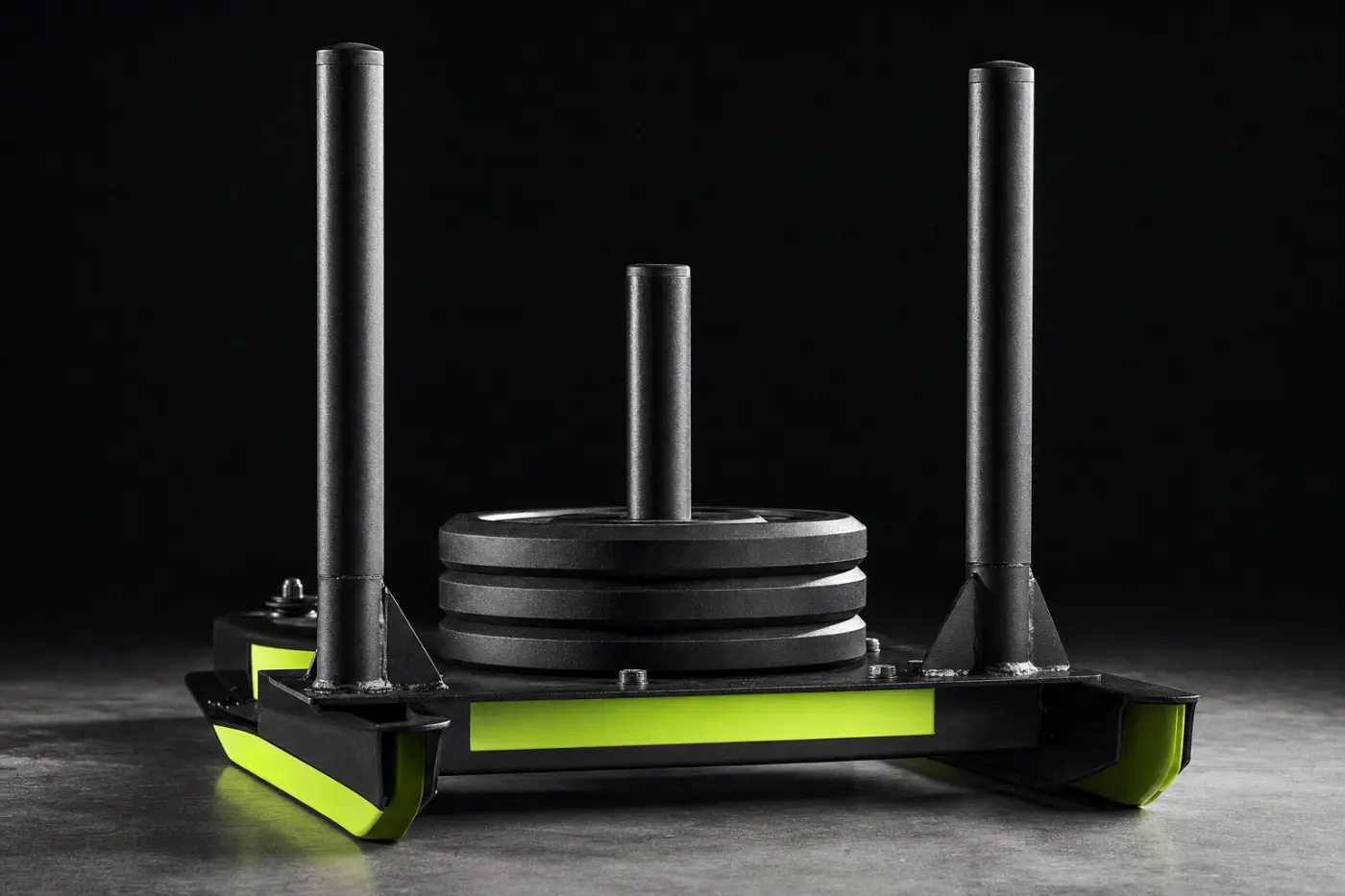
Sled Push and Pull: Technique That Saves Minutes, Not Seconds
The two stations with the widest spread of times between athletes of similar fitness, because both are heavily technical. Body position, step length, rope mechanics, and why floor friction varies so much between venues.

Wall Balls: The Station That Decides Your Last Ten Minutes
The final station, the one most likely to fall apart, and the one where a rehearsed set structure is worth minutes. Technique that saves your shoulders, how to break the reps, and what to do when the reps start getting no-repped.

Planning a HYROX Season: How Many Races a Year?
Racing too often means never building, and racing once a year means never learning to execute. How to structure a year around two or three genuine attempts, what to treat as a training race, and when to take an off-season.